Saturday, February 13, 2010

Dish mayor puts fear of frack into natural gas industry

The Dallas Morning News

2:57 PM Fri, Feb 12, 2010

Elizabeth Souder/Reporter

Posted at Bluedaze by TXSharon regarding the controversial "Energy in Depth" press release, according to The Dallas Morning News :

"The natural gas industry is paying inordinate attention to Calvin Tillman, the mayor of tiny Dish, Texas.

Sure, he's the guy who commissioned the air quality study that has triggered more studies around the Barnett Shale, as well as political chatter about drilling moratoriums and new regulations.* If these things come to pass, drilling and completing natural gas wells could become much more expensive for producers.

The typical -- and wholly expected -- industry response has been to point out the limitations of the Dish air quality study and to counter the results with other data.

But something has changed in the past few weeks. As Mayor Tillman heads to New York and Pennsylvania next week to tell his story in six towns, industry groups have begun to attack.

Now, the Texas Pipeline Association has told Tillman it will officially request a list of the people who contributed to the town's legal fund.

And an industry advocacy group called Energy in Depth issued a snarky press release that poses questions to Tillman. The questions are designed to show that natural gas drilling isn't as worrisome as Tillman might say.

So why is the natural gas industry so afraid of the mayor of a town of 362 people?

"We are very concerned about what's happening in New York, so anytime someone comes to exaggerate or possibly lie about their experiences, we're going to fight that," said Jeff Eshelman, a spokesman for Energy in Depth.

As I've stated on this blog before, I think natural gas executives worry that if regular people become fearful of drilling, politicians will place stlff regulations on the industry and people won't be very eager to lease their land to producers. Those outcomes could make drilling and completing a well more expensive, and, in some cases, unprofitable.

Jump for the Energy in Depth press release." More>>>>

* Study, Texas Oil & Gas Accountability Project, "Community Health Survey Shows Shale Gas Threatens Human Health ."

Along these lines, NM HB 259 is scheduled to be head this morning. See link at Common Ground United: Update: HB 259 Support the private right to enforce environmental statutes

Thursday, February 11, 2010

Update: HB 259 Support the private right to enforce environmental statutes

In regards to HB 259, not only is it sponsored by Representative Ben Lujan, Speaker of the House, but it has the support of the NM Attorney General Gary King, Please help support the bill. See the Earthworks Action Alert:

EARTHWORKS action alert (for web version, click here>>>>)

Support the private right to enforce environmental statutes

UPDATE: Bill passes Consumer & Public Affairs Committe (thanks for your calls!)
On to the House Judiciary Committee!

Call New Mexico state legislators now
(see legislator list at bottom of alert)

WHAT:

House Bill 259

Sponsored by: Representative Ben Lujan, Speaker of the House

Is scheduled to be heard in House Judiciary Committee

WHEN:

TBA: we expect either Friday or Saturday

1:30 pm

Room 309

State Capitol Building - Santa Fe, New Mexico

SUGGESTED TALKING POINTS:

Urge legislators to vote YES on House Bill 259 (the Private Right Action Act)

HB 259 allows affected landowners to file suit to enforce environmental laws, or to spur government action, when the government fails to take action against a violation of the law.

Based on New Mexico's experience with similar laws - the Surface Mining Act (passed in 1979) and the Mining Act (1993) - HB 259 won't result in frivolous lawsuits. Only two suits have ever been filed under these laws and neither suit resulted in judgment against the State.


FOR MORE INFORMATION:

House Bill 259 - bill language: http://legis.state.nm.us/Sessions/10%20Regular/bills/house/HB0259.pdf

HB 259 - Fiscal Impact Report:
http://legis.state.nm.us/Sessions/10%20Regular/firs/HB0259.pdf

LEGISLATORS TO CALL

House Judiciary Commitee Members:
Please contact these legislators today! For a full list of committee members:
http://legis.state.nm.us/lcs/committeedisplay.aspx?CommitteeCode=HJC

IF YOU ONLY HAVE TIME TO MAKE A FEW CALLS:

Representative Eliseo Lee Alcon
Capitol Phone: (505) 986-4254
Email: eliseoalcon@msn.com This e-mail address is being protected from spam bots,

Representative Elias Barela
Capitol Phone: (505) 986-4235
Email: elias@barelalaw.com This e-mail address is being protected from spam bots,

Representative Joseph Cervantes
Capitol Phone: (505) 986-4249
Email: cervanteslaw@zianet.com This e-mail address is being protected from spam

Representative Mimi Stewart
Capitol Phone: (505) 986-4840
Email: mstewart@osogrande.com

‘Bad actor’ legislation (HB 276) dies on House floor

The New Mexico Independent

By Trip Jennings 2/10/10 9:10 PM

coal-power-plant-pic1"House lawmakers on Wednesday narrowly rejected giving power to state environmental regulators to consider a company’s past crimes and regulatory punishments in other states when deciding whether to revoke or deny an air quality permit.

The bill died on the House floor Lawmakers on a 32-33 vote after a lengthy, sometimes testy debate.

Supporters cast the bill in terms of protecting the poorest New Mexicans from pollution. Opponents countered that it changed the regulatory rules mid-stream and would send a anti-business message to firms that want to relocate here.

The legislation, sponsored by Rep. Brian Egolf, D-Santa Fe, would have empowered the New Mexico Environment Department and Bernalillo County to consider “bad actor” provisions when weighing decisions related to a permit.

New Mexico has “five or six bad actors” that continue to emit air pollution and contamination that could lead to death despite repeated sanctions, Egolf told his colleagues.

“If we can’t come together to help some of the poorest people in New Mexico get out from under clouds of pollution … then I don’t know what to say,“ Egolf said. “There are companies operating in New Mexico that shouldn’t be. We’ve got to stop it.”

But several lawmakers opposed the bill, citing, among other things, its retroactivity." More>>>>

2010 Regular Session


HB 276

AIR QUALITY CONTROL PERMIT DENIAL


Sponsor: Brian F. Egolf

Current Location: Died

Wednesday, February 10, 2010

PIONEERING FEDERAL CLIMATE AND ENERGY LAWSUIT TO MOVE FORWARD

AMIGOS BRAVOS ♦ COMMON GROUND UNITED ♦ NATURAL RESOURCES DEFENSE COUNCIL ♦ OIL AND GAS ACCOUNTABILITY PROJECT/EARTHWORKS ♦ SAN JUAN CITIZENS ALLIANCE ♦ SOUTHWEST ENVIRONMENTAL CENTER ♦ WESTERN ENVIRONMENTAL LAW CENTER

NEWS RELEASE

For Immediate Release: February 10, 2010

Contact:
§ Erik Schlenker-Goodrich, Western Environmental Law Center, 575.613.4197
§ Mike Eisenfeld, San Juan Citizens Alliance, 505.360.8994

PIONEERING FEDERAL CLIMATE AND ENERGY LAWSUIT TO MOVE FORWARD Conservation Groups Win Legal Victory Against U.S. Bureau of Land Management

Taos, New Mexico. A Federal Judge has rejected an attempt by the U.S. Bureau of Land Management to dismiss a pioneering lawsuit filed by conservation groups. The lawsuit, filed last year, seeks to safeguard the climate by requiring BLM to account for the climate change impacts of its oil and gas leasing decisions. In particular, the lawsuit seeks to compel BLM to require oil and gas companies to use cost-effective, proven technologies and practices which keep methane – a potent greenhouse gas at least 25 times stronger than carbon dioxide – out of the atmosphere and in the pipelines for homes, schools, and businesses.

“Secretary of the Interior Ken Salazar is bringing much-needed reform to the BLM’s leasing program,” said Mike Eisenfeld with the San Juan Citizens Alliance. “However, leasing reform must account for climate pollution caused by federally-authorized oil and gas development to protect our shared climate. Our lands, rivers, streams, farms, and communities are at risk.”

The U.S. Environmental Protection Agency (“EPA”) estimates that oil and gas operations are the largest human-made source of methane and account for 24% of total methane emissions in the United States. Fortunately, EPA has established the “Natural Gas STAR” program to encourage oil and gas companies to cut methane waste to reduce global warming pollution and recover value. EPA has identified over 120 technologies and practices to effectively reduce methane waste and make operations more efficient. For calendar year 2008, EPA estimated that this program avoided 46.3 million tons of CO2 equivalent, equal to the annual greenhouse gas emissions from approximately 8.5 million passenger vehicles or 6 million homes per year, and added revenue of nearly $802 million in natural gas sales – revenue which translates into additional royalties for the American public. Despite these economic and environmental gains, BLM does not require the use of these proven and profitable technologies.

“It is simply unacceptable that BLM isn’t requiring oil and gas companies which lease – and let me emphasize this – public resources to use the best available solutions to reduce waste and safeguard our climate,” said Erik Schlenker-Goodrich, the Director of the Western Environmental Law Center’s Climate and Energy Program, and the conservation groups’ attorney. “The Federal Court’s ruling rejects BLM’s attempt to close the courthouse door to conservation groups and the very important issue of climate change. We now look forward to presenting our case that BLM’s oil and gas leasing decisions have ignored and rejected common-sense climate and energy solutions."

What you need to know about natural gas production

Now posted at Common Ground United under "Links," then under "Drilling Education," an excellent natural gas production link with video, spreadsheets, information about pit chemicals and drilling & fracturing chemicals, and photos:

"What you need to know about natural gas production

TEDX The Endocrine Disruption Exchange Chemicals in Natural Gas Operations What you need to know about natural gas production Dr. Colborn has delivered her talk "What You Need to Know About Natural Gas Production" many times across the country."

Development receives approval

Local news in brief, Feb. 10, 2010
| The New Mexican
Posted: Tuesday, February 09, 2010

"The Santa Fe County Commission granted preliminary plat and development plan approval Tuesday for the first phase of what could one day be a massive mixed-used development in the Galisteo Basin.

Tuesday's 4-0 vote approved preliminary plans for Trenza — formerly called the Village at Galisteo Basin Preserve — a 149-unit housing development that will be part of a larger project, which could eventually include 965 homes as well as schools, shops and thousands of acres of preserved open space." More>>>>

(Santa Fe) County mulls 60 job cuts

Finance director paints grim picture of finances

Phaedra Haywood | The New Mexican
Posted: Tuesday, February 09, 2010

"Santa Fe County might have to cut as many as 60 jobs in order to balance its budget for next year.

Finance Director Teresa Martinez presented a grim picture of the county finances to commissioners during a budget study session Tuesday.

She blamed falling gross-receipts tax revenues, costly legislative mandates and deficits in several county departments.

In addition to eliminating jobs, the county might have to cut funding to numerous programs including youth services, libraries, transportation and county satellite offices.

Shortfalls in certain departments — including corrections, health and fire — can be made up by using cash reserves from the general fund this year, Martinez said.

But without sweeping reform, she said, those reserves will likely be depleted within the next two years, causing the county to violate its own rules requiring minimum cash reserves. " More>>>>

As of this posting, the Santa Fe Chamber of Commerce reflected that the County of Santa Fe has 445 employees. So, 60 into 445 equals 13.5% employee reduction.

Santa Fe County land plan workshops begin today

KSFR


"-- Feb. 10, 7 a.m. -- Beginning today, Santa Fe County officials will hold the first of a number of small-group workshops for the public on the new land development plan. They're set for every Wednesday and Thursday from 2 p.m. to 4 p.m. over the coming weeks.

Wednesday, February 10 - Organization of workshops and discussion on Chapter 1: Vision and introduction to Chapter 2: Land Use Element

Thursday, February 11- Discussion on Chapter 2: Land Use Element and introduction to Chapter 14: Governance Element

Wednesday, February 17 - Continued discussion on Chapter 2: Land Use Element and introduction to Chapters 3 and 4: Agriculture and Ranch and Economic Development Elements

Thursday, February 18 - Discussion on Chapter 14: Governance (Includes Community Planning) and introduction to Chapters 5 and 6: Resource Conservation and Open Space Elements

Wednesday, February 24 - Discussion on Chapter 3 and 4: Agriculture and Ranch and Economic Development Elements also introduction to Chapters 7 and 8: Renewable Energy and Sustainable Green Design and Development Elements

Thursday, February 25 - Discussion on Chapters 5 and 6: Resource Conservation & Open Space, Trails, Parks Areas and introduction to Chapter 13: Housing

Wednesday, March 3 - Discussion on Chapters 7 and 8: Renewable Energy & Sustainable Green Design and Development Elements and introduction to Chapter 11: Water, Wastewater, and Stormwater Management Element

Thursday, March 4- Discussion on Chapter 13: Housing Element and introduction to Chapter 12: Adequate Public Facilities and Finance
(Please Note March 4 meeting will be in the Legal Conference Room, 102 Grant Ave.)

Wednesday, March 10 - Discussion on Chapter 11: Water, Wastewater, and Stormwater Management Element and introduction to Chapters 9 and 10: Public Safety and Transportation Elements

Thursday, March 11 - Discussion on Chapter 12: Adequate Public Facilities and Finance Element

Wednesday, March 17 - Discussion on Chapters 9 and 10: Public Safety and Transportation Elements

Additional Meetings will be scheduled as necessary. If you would like to participate in these workshops, receive the entire document electronically, or receive an individual chapter electronically, contact Melissa Holmes, 995-2717. For more information about the Sustainable Land Development Plan process, contact Robert Griego, 986-6215. You may also visit our website at www.santafecounty.org."

Tuesday, February 9, 2010

Update: House Bills 254 & 259

HB 254 is basically dead, or least without a pulse:

EARTHWORKS: Bill Would Prohibit Municipalities that Regulate Extractive Industries from Receiving Severance Tax Revenue


HB 259 passed and is on to the next committee (see actions):

EARTHWORKS: Support the private right to enforce environmental statutes

Santa Fe County small-group meetings on land development plan

KSFR

"Santa Fe County officials plan a series of discussions with local residents about the latest draft of the Sustainable Land Development Plan. Those public meetings could begin as early as this week. County Commissioner Kathy Holian says they're designed to get public input before another draft is written. The plan now is about 300 pages, down from the 1,200 pages in the first draft. The oil and gas component of the plan has been omitted from these discussions since it is already completed. To find out about these small-group meetings, contact Melissa Holmes, 995-2717 or msholmes@santafecounty.org, or Planning Manager Robert Griego at 986-6215 or rgriego@santafecounty.org."

http://www.publicbroadcasting.net/ksfr/news.newsmain/article/0/0/1609523/KSFR.Local/Exclusive.Santa.Fe.County.plans.small-group.meetings.on.Land.Plan


Monday, February 8, 2010

EARTHWORKS: Support the private right to enforce environmental statutes

EARTHWORKS: Support the private right to enforce environmental statutes
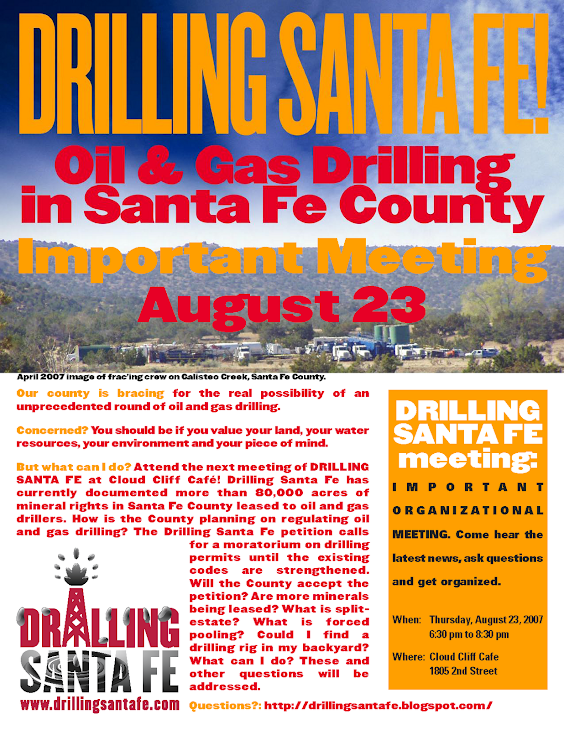
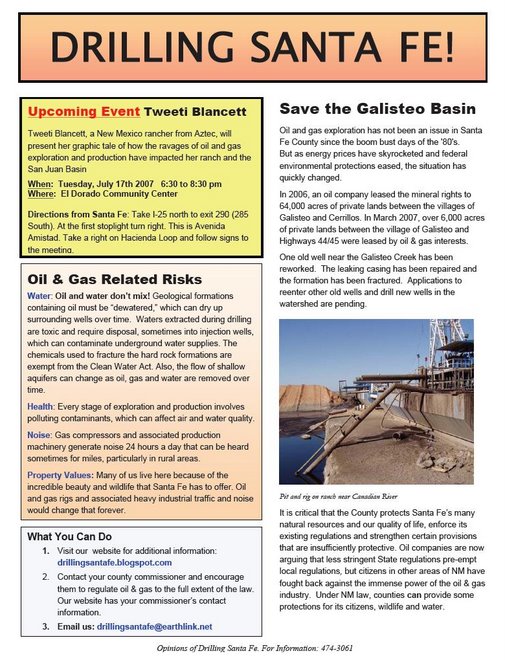
Call New Mexico state legislators now
(see legislator list at bottom of alert)

WHAT:

  • House Bill 259
  • Sponsored by: Representative Ben Lujan, Speaker of the House
  • Is scheduled to be heard in House Consumer and Public Affairs Committee tomorrow

WHEN:

  • Tuesday, February 9, 2010
  • 1:30 pm
  • Room 315
  • State Capitol Building - Santa Fe, New Mexico

SUGGESTED TALKING POINTS:

  • Urge legislators to vote YES on House Bill 259 (the Private Right Action Act)
  • HB 259 amends the Environmental Improvement Act, the Water Quality Act and the Oil and Gas Act to allow private citizens to enforce the pollution provisions of those statutes
  • At a time when our state budgets are tight and state agencies have limited resources to enforce existing environmental laws, regulations and permits, this bill will provide citizens with an important tool to clean up their own backyards and communities.
  • HB 259 will supplement the environmental enforcement ability of state agencies at a time of limited budgets
  • HB 259 will enable local citizens to sue a company that is polluting and get a court order to make the company stop polluting
  • HB 259 will make it possible for local groups that might not have the resources to get reimbursed for litigation costs, including legal fees and expert fees, should the local group prevail
  • HB 259 will require that the state receive any civil penalties ordered by the court
  • HB 259 will not add to the state deficit

Conservation Voters New Mexico has this to say about the Private Right of Action bill:

The bill would be a crucial tool giving residents the power to demand compliance with, and enforcement of, these three crucial environmental laws.
Essentially, an agency that is either willfully derelict or simply incompetent in carrying out its statutory duties could be ordered by the court to perform its mandate. Or, in the same vein, if a violation is ongoing and the agency fails to act, for the first time a citizen will have the power to stop it via injunction.
A novel component to the bill is the $25,000 (or less) beneficial mitigation clause. Essentially, if an individual sues another individual for damages under any of the acts, any penalty will go to the same fund in which it would be deposited if the action had been brought by the agency itself, and up to $25,000 of that penalty may be directly used to mitigate the specific damages caused by the violation. This clause helps to guard against a situation where an agency not only initially fails to enforce an act, but also fails later to rectify the damages of its non-enforcement.
If this bill passes, willful or unwillful enforcement failure will never be a complete barrier to ensuring that the laws protecting New Mexico's environment may nonetheless still be fully enforced.

BACKGROUND:
The Fiscal Impact Report for HB 254 states:

The intent of citizen suit legislation, such as HB 259, is to allow private rights of action to enforce environmental laws, or to spur government action, when the government fails to take action against a violation of the law. Federal environmental laws generally contain citizen suits provisions and New Mexico's two major mine regulatory laws include citizen suit provisions.NMSA 1978, Section 69-25A-24 (Surface Mining Act) and Section 69-36-14 (Mining Act). Both laws allow for EMNRD to be sued. These provisions, which have been in place since 1979 and 1993 respectively, have rarely been used. There are no records of any citizen suits under the Surface Mining Act and only two under the Mining Act. Neither suit resulted in any judgments against the State.

FOR MORE INFORMATION:

  • House Bill 259 - bill language: http://legis.state.nm.us/Sessions/10%20Regular/bills/house/HB0259.pdf
  • HB 259 - Fiscal Impact Report:
    http://legis.state.nm.us/Sessions/10%20Regular/firs/HB0259.pdf

LEGISLATORS TO CALL

Committee Members:
Please contact these legislators today! For a full list of committee members:

http://legis.state.nm.us/lcs/committeedisplay.aspx?CommitteeCode=HCPAC

IF YOU ONLY HAVE TIME TO MAKE A FEW CALLS:

  • House Consumer and Public Affairs:
    Please contact these Committee Members today!
  • Representative Gail Chasey - (D) - Committee Chair
    Capitol Phone: (505) 986-4844
    Email: gailchasey@msn.com
  • Representative Antonio "Moe" Maestas - (D) - Committee Vice-Chair
    Capitol Phone: (505) 986-4464
    Email: rep16@moejustice.com
  • Representative Karen Giannini
    Capitol Phone: (505) 986-4234
    Email: nmhousedistrict30@live.com
  • Representative Bill O'Neill
    Capitol Phone: (505) 986-4254
    Email: oneillhd15@fastmail.us
  • Representative Al Park
    Capitol Phone: (505) 986-4411
    Email: alpark.nm@gmail.com

EARTHWORKS: Bill Would Prohibit Municipalities that Regulate Extractive Industries from Receiving Severance Tax Revenue

From EARTHWORKS:

To see a web version of the alert below, go to:
http://www.commongroundunited.org/index.php?option=com_content&task=view&id=1119&Itemid=1&mosmsg=Item+successfully+saved.


Bill Would Prohibit Municipalities
that Regulate Extractive Industries
from Receiving Severance Tax Revenue

Call New Mexico state legislators now to allow common sense to prevail
(see legislator list at bottom of alert)

Jurisdictions that host drilling and mining should be able to govern it in the public interest AND receive taxes generated by it

WHAT:

House Bill 254
Sponsored by: Representative Keith Gardner (Roswell)
Is scheduled to be heard in House Health and Government Affairs Committee tomorrow
WHEN:

Tuesday, February 9, 2010
8:30 am
Room 309
State Capitol Building - Santa Fe, New Mexico
SUGGESTED TALKING POINTS:

Urge legislators to vote NO on House Bill 254
Counties with oil and gas and other types of mineral development bear the most impact and should be recipients of severance tax funds - regardless of the regulations they have in place!
One of the core ideas behind "severance" taxes is to give something back to the regions that have minerals that have been "severed" - or "extracted" from the earth. Once they are gone, they are gone.
Severance taxes provide communities with an opportunity to develop projects and programs that will have a lasting legacy.
This bill appears to be an attempt to punish counties that have adopted (or are considering adopting) common sense regulations that prevent and reduce the impacts caused by mining and oil and gas development.
This bill is similar to Senate Bill 8 sponsored by Senator Bill Sharer from Farmington. Stay tuned for alerts on this bill.

BACKGROUND:
The Fiscal Impact Report for HB 254 states:

Significant issues
HB 254 would have a significant impact on the funding of vital capital projects in those municipalities and counties whose ordinances are construed as having an onerous effect on extractive industries. Some municipalities and counties may have unique, very compelling reasons for such ordinances due to serious past pollution, probability of complications and associated costs, fragile terrain, vulnerable populations, etc. However, HB 254 will penalize all the same regardless of their distinct circumstances and severity of risk associated with some ordinances deemed burdensome.
The New Mexico Municipal League is concerned that the funding capabilities for the counties and municipalities would be adversely affected and could result in significantly restricting reliable funding resources. This bill will also affect certain Local Tribal Government Agencies by limiting the availability of future severance tax funding for projects within targeted counties. Santa Fe County is opposed to this bill since they have enacted oil and gas ordinance that could be later deemed onerous and result in prohibiting severance tax bond proceeds for needed capital projects.
FOR MORE INFORMATION:

House Bill 254 - bill language:
http://legis.state.nm.us/Sessions/10%20Regular/bills/house/HB0254.pdf
HB 254 - Fiscal Impact Report:
http://legis.state.nm.us/Sessions/10%20Regular/firs/HB0254.pdf
LEGISLATORS TO CALL

Committee Members:
Please contact these legislators today! For a full list of committee members:
http://legis.state.nm.us/lcs/committeedisplay.aspx?CommitteeCode=HHGAC

IF YOU ONLY HAVE TIME TO MAKE A FEW CALLS:

House Health and Government Affairs:
Please contact these Committee Members today!
http://legis.state.nm.us/lcs/committeedisplay.aspx?CommitteeCode=SCONC
Representative Mimi Stewart - (D) - Committee Chair
Capitol Phone: (505) 986-4840
Email: mstewart@osogrande.com
Representative Jeff Steinborn - (D) - Committee Vice-Chair
Capitol Phone: (505) 986-4248
Email: jeff.steinborn@nmlegis.gov
Representative Eleanor Chavez
Capitol Phone: (505) 986-4464
Email: eleanorchavez@gmail.com
Representative John Heaton
Capitol Phone: (505) 986-4432
Email: jheaton@caverns.com
Representative Luciano "Lucky" Varela
Capitol Phone: (505) 986-4318
Representative Jeannette Wallace
Capitol Phone: (505) 986-4452
Email: wallace@losalamos.com

Friday, February 5, 2010

Susana Martinez running for Governor by bashing the Santa Fe County Oil and Gas Ordiance & the OCD Pit Rule?

nmpolitics.net

NM’s energy industry is crucial to future growth

Excerpt:
"But the troubling actions on the part of the current administration (Richardson) do not stop there. They have sent mixed signals to the industry and changed the rules in the middle of the game. For example, those interested in exploration in the Galisteo Basin complied with every state regulation – only to face roadblocks erected by Santa Fe County and supported by the Richardson/Denish administration.

Not only does that have the obvious negative impact on exploration and development, but it also undermines the state’s credibility with the business community when its word cannot be trusted.

These anti-business policies were driven by extreme special-interest groups and had little to no basis in fact. In essence, the Richardson/Denish administration killed New Mexico jobs and reduced funding for our schools in order to satisfy the narrow ideology of special interests.

And while, like on so many other issues, Diane Denish will try to claim distance from the administration’s actions, it is important that voters understand that certain members of the Oil Conservation Commission (OCC) are appointed by the executive branch and responsible for many of the state’s regulations, such as the pit rule. In turn, they report to the governor and lieutenant governor, not the Legislature or anyone else.

The folks who have held sway over both the OCC and the environmental department have been long-time Denish friends and supporters."

There seems to be confusion of facts in the opinion piece, in addition to Santa Fe County standing up to protects its citizens and resources, Rio Arriba County adopted an oil and gas ordinance and San Miguel County adopted a one year oil and gas drilling moratorium in order to draft an oil and gas ordinance.

As fragile ecosystems are targeted for oil and gas exploration and extraction that yield many adverse impacts, and as the legislature continually eviscerate the Oil Conservation Division (OCD) budget and effectiveness by maintaining the current antiquated OCD fining system, local authority will have to step in to protect the public heath, safety and welfare. The drafting and adoption of the Santa Fe County Oil and Gas Ordinance was based on a lengthy process that included a consulting attorney, a consulting land use firm, and oil and gas experts. So this begs the question, is local authority to be denied by the State? And is the protection of water, land, air, wildlife, public health and safety, cultural resources, and existing local economics the "ideology of fringe, special interest groups"?

As for, "I will ensure that the regulatory process is one driven by facts and evidence, not by political winds." Really? She just politicized it in this opinion piece.

For link to the article, click here>>>>

As for the Pit Rule issue, see the following post:

Oil Patch Times: 2009 economics

As for ennobling the oil and gas industry, see the following post:

Gallagher's out as NMOGA president


Wednesday, February 3, 2010

Gas rallies stoke Albany

TRR photo by Sandy Long

As the natural gas drilling expands to other parts of the country, citizens weigh in.

The River Reporter


Opponents, supporters and politicians weigh in

By SANDY LONG

"ALBANY, NY — Residents of New York and Pennsylvania, along with various environmental and community groups, rallied at the New York State Capitol in Albany on January 25 to raise awareness of the multi-faceted issues related to the natural gas exploration coming to both states. Participants also lobbied state legislators and Governor David Paterson.

Those in support of drilling focused on the economic benefits associated with the activity, citing the influx of income, jobs and the opportunity to save struggling farms from development. Those opposed to the activity targeted the protection of drinking water and called upon the New York State Department of Environmental Conservation to withdraw its Supplemental Generic Environmental Impact Statement (SGEIS) to include evaluation of the cumulative impacts of drilling and more." Article link>>>>

Related post from July 2008 regarding an article in The River Reporter about the Galisteo Basin and Santa Fe County moratoria:

New Mexico gas moratorium


Oil Patch Times: 2009 economics

Los Alamos Monitor

By Don Neeper, John Bartlit

"Going on four years now, lobbyists for New Mexico’s oil and gas industry have said the “Pit Rule” should be based on sound science.

If they wanted to be judged on facts, they would supply a decent sampling of information. Instead, their pitch crumbles into raw politics as other information pops out in print.

The full story begins with the hundred thousand oil and gas wells drilled in New Mexico over the years, and continues with the tens of thousands of new wells slated to be drilled. Each well has a surrounding work area, called a “drill pad,” of one to five acres, accessed from the highway by a network of dirt roads long enough to reach every well.

Where geologic formations hold substantial oil and gas, the result resembles a giant Chinese checkerboard of well sites laid on ranch land, forest land or BLM land.

As with car exhaust, problems that are small at first grow as they occur on a larger scale. A notable issue is what happens with the drilling wastes.

“Drilling wastes” include “drilling mud,” a commercial product of clay and unstated ingredients that works as a lubricant and pressurant in drilling. Then come wastes of crude oil and salt from brine.

The industry aims to bury its highly salty wastes at the well sites, or “pits.” This would not be too bad if the salt would never move and no one would ever disturb the land.

But if the salt dumped in the land moves, as by rainfall, water in soil or a future use of land, bad things happen. The loss is to the land if the salt moves up or spreads out. The loss is to aquifers beneath if salt moves downward.

What is known and not known about the science of salt moving in soils and key factors like the lifetimes of thin plastic pit liners, occupied 17 days of expert technical testimony, most of it hired, at state hearings on the Pit Rule. To test for truth, every technical witness is subject to lengthy cross-examination by teams of lawyers, also hired, working to spot holes in the testimony.

But don’t take my word for it; see the 5,075 pages of verbatim record and technical exhibits from the hearing.

The two years of work plus weeks of testimony yielded final rules known collectively as the “Pit Rule.”

After the rule was adopted, the industry went to the governor to get it relaxed. With the governor’s weight in the picture, a new hearing raised the limits on salt buried widely in pits or trenches.

Now another piece of news shows up, hoping to muddle the science with more politics. On the Internet, Susana Martinez, candidate for governor, declares, “The pit rule has no scientific basis and must be removed immediately.” As tutored by the oil and gas lobby, her one-liner ignores the sum of the 5,075-page hearing record.

The political hopeful also shaves the economics down to nothing, again tutored by the oil and gas lobby. She declares: “It’s costing our state millions of dollars in revenue.

Revenue from the gas and oil industry is down from 21 percent (in past years) to around 13 percent in 2009.” (Artesia Daily Press, Dec. 23, 2009).

This sliver of fact ignores the big story printed on the front page of the Albuquerque Journal a month earlier on Nov. 20. The headline read: “N.M. Falls Hard Into Recession — Federal Reserve official says energy-producing states hurting.”

The Journal story says energy-producing states are being hit by low demand and low prices for oil and gas. As the overall economy fell, energy demand fell, the effect of which is now hitting energy-producing states, such as “New Mexico, Colorado, Oklahoma and Wyoming.” The cause is not N.M.’s Pit Rule. In all states, oil revenues are down because oil prices are down.

The Federal Reserve analyst said, “I think we hit the life-time low in oil prices last summer. The lower energy prices help the national economy recover but hurt energy producers.”

The front-page news also reports: “Meanwhile, natural gas prices are being depressed by abundant new supplies coming from shale deposits in Texas, Arkansas and the eastern United States.”

The public could judge oil and gas on facts, if the industry lobby did not cover up the science record and economic facts.

Meanwhile, the nation’s oil industry fights for more drilling of sites with higher costs than New Mexico, as in Gulf waters and Alaskan tundra."

Article link>>>>


Thursday, January 28, 2010

Gallagher's out as NMOGA president

bizjournals.com

January 28, 2010 7:56 PM ET

Kevin Robinson-Avila

"Bob Gallagher, who has led the New Mexico Oil and Gas Association for a decade, is no longer its president.

Gallagher said in an interview Thursday that the organization has “terminated” him from his position.

“As of yesterday, NMOGA bought out my contract and terminated me,” Gallagher said. “They say I damaged the image and reputation of NMOGA so bad that I am no longer effective in representing the oil and gas industry.”' More>>>>


Wednesday, January 27, 2010

Legislture in session. Time for bad bills: HB 192 RESCIND OIL & GAS PIT RULES

2010 Regular Session

* HB 192 RESCIND OIL & GAS PIT RULES

Sponsor: Thomas C. Taylor

Current Location: House Rules & Order of Business Committee


Text Document PDF Document Introduced (1/27/10)

Yet, according to OGAP (Oil & Gas Accountability Project), "Pits under the new rule: lined, permitted, more respectful of water and property.

The new pit rule bans unlined pits entirely and requires that all pits are permitted with the Oil Conservation Division (OCD). At long last, the public will finally have an inventory of pits in our state! The new rule also strengthens liner requirements and effectively requires the use of closed loop systems in close proximity to our water resources and homes.

The Oil & Gas Accountability Project (OGAP) maintains that the industry will end up saving money in the long run by moving to closed-loop systems. Mary Ellen Denomy, Petroleum Accountant, told the Oil Conservation Commission that closed-loop systems saved 3% per well. Denomy stated that companies were able to cut costs on construction, water, drilling muds and waste disposal when utilizing closed-loop systems. View OGAP's Op-ed." More>>>>

So, why does Representative Taylor think that the pit rules are a bad idea?

Representative Thomas C. Taylor - (R)

District: 1
County: San Juan
Representative Since: 1999
Occupation: Investments
Address: 5909 Rinconada

Farmington, NM 87402
Capitol Phone: (505) 986-4757
Office Phone: (505) 320-0306
Home Phone: (505) 325-9828
E-mail: tom@tomtaylor.net

Friday, January 15, 2010

(San Miguel) County enacts drilling moratorium

Las Vegas Optic

15 January 2010

By David Giuliani

"The San Miguel County Commission passed a year-long moratorium on permits for oil and gas drilling — a move supported by everyone who spoke before the panel, including an industry spokeswoman.

No one has approached the county about possible drilling, but companies have proposed such activity in neighboring Mora and Santa Fe counties.

In calling for the moratorium, the county plans to form a task force and seek the advice of experts to develop a new ordinance for drilling. The current land-use ordinance includes just a half page dealing with such activity.

More than 20 speakers came before the commission to urge the moratorium’s passage." More>>>>


Proposed Tougher Ozone Standard Worries Intermountain West Drillers

The New York Times

By SCOTT STREATER of Greenwire

Published: January 14, 2010

"More than a dozen Western counties with high levels of oil and gas drilling could face tougher requirements for ozone pollution under new proposed federal standards rolled out last week, adding another dose of regulatory uncertainty to an industry already facing tougher scrutiny over its air emissions."...

..."In New Mexico, which currently meets federal health standards for ozone statewide, two counties -- Rio Arriba and San Juan in the state's Four Corners region -- could fall into nonattainment largely because of power plant emissions, as could several others on the state's southeast side, "where there's a lot of oil and gas development," said Mary Uhl, air quality bureau chief for the New Mexico Environment Department.

While New Mexico has been more cautious than some other Intermountain states about new drilling, it remains in the top five natural gas producing states, with most of the gas coming from the San Juan Basin in northwestern New Mexico and the Permian Basin in the south.

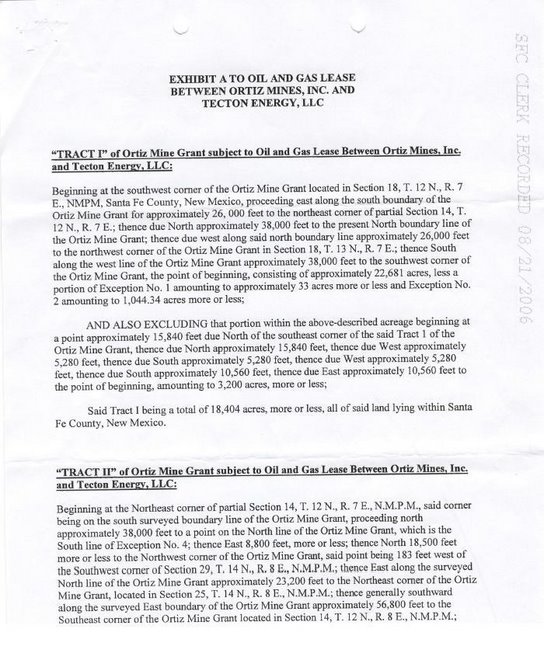
In 2008, Gov. Bill Richardson (D) joined Santa Fe County in imposing a moratorium on oil and gas drilling in the Galisteo Basin south of Santa Fe after environmental groups complained that a proposal to drill new exploratory wells there would harm the area's environment and important archaeological and cultural resources.

Included in Richardson's executive order was that the New Mexico Environment Department consider adopting new air quality regulations to further protect ambient air quality from drilling activity in the basin.

The developer, Tecton Energy of Houston, later abandoned the proposal." More>>>>


Tuesday, January 12, 2010

San Miguel County Board of County Commissioners Pass Oil and Gas Drilling Permit Moratorium

Today, the San Miguel County Board of County Commissioners passed and adopted a one year oil and gas drilling permit moratorium.

See related post:

(San Miguel) County Wants Drilling Rules

Saturday, January 9, 2010

Environmentalists debate whether natural gas is safer for the environment

Staci Matlock | The New Mexican
Posted: Friday, January 08, 2010

"New Mexico is a top producer of natural gas and some environmentalists see the fuel as a more environmentally friendly energy choice than coal.

But is it?

Carl Pope, executive director of the Sierra Club, sees well-regulated natural gas production as a good way to transition from coal and oil to renewable sources like solar, wind and biofuels. "Natural gas is an excellent example of a fuel that can be produced in quite a clean way, and shouldn't be wasted," he said. "We see it as part of the energy transition to a post-fossil fuel economy."

But Johnny Micou, who helped martial a grass-roots effort to stop exploratory oil and gas drilling in the Galisteo Basin near Santa Fe, said the environmental impact of unconventional drilling practices that are allowing industry to tap into new natural gas sources have not been thoroughly studied. "The cumulative environmental impacts of drilling need to be considered," he said.

Micou thinks the Sierra Club needs to take a tougher stand. Supporting natural gas as a "transition" fuel only delays the sense of urgency needed to make a real and substantial shift in energy sources. "There are parts where we (he and Pope) agree, but I would like to see more strides now and a significant change from the way we do energy sources and automobiles," Micou said. "Soft-pedaling on industry now is going to perpetuate the problem."

New Mexico is the fourth- or fifth-largest producer of natural gas in the country every year and revenues generated from the billions of cubic feet extracted are a big boost for the state. Most of the natural gas comes from the San Juan Basin in northwestern New Mexico and the Permian Basin in the south. Now energy companies are eyeing basins from Tucumcari to Mora that are potentially rich in natural gas." More>>>>

~~~

Related article:

The Wall Street Journal

Sierra Club's Pro-Gas Dilemma

By BEN CASSELMAN

December 22, 2009

"LIVERPOOL, N.Y. -- When energy companies began preparations to drill for natural gas in upstate New York last year, the local Sierra Club quickly organized against them.

The group's New York chapter demanded studies on the environmental risks, pushed for stricter regulations and called for a statewide ban on most gas drilling. The drilling hasn't begun as the state works to develop regulations.

It would have been a typical story of environmentalists battling industry, except for one thing: The national Sierra Club is one of natural gas's biggest boosters.

Carl Pope, the Sierra Club's executive director, has traveled the country promoting natural gas's environmental benefits, sometimes alongside Aubrey McClendon, chief executive of Chesapeake Energy Corp., one of the biggest U.S. gas companies by production.

The national group's pro-gas stance has angered on-the-ground environmentalists in several states who say their concerns are being marginalized." More>>>>

Link to Sierra Club new national policy on gas>>>>


Friday, January 8, 2010

Amid strife, first Whites Peak land swap closes

Staci Matlock | The New Mexican
Posted: Thursday, January 07, 2010
- 1

"Angry hunters and skeptical public officials Thursday grilled state Land Commissioner Pat Lyons over a controversial package of state trust-land trades around Whites Peak.

The confrontation at the state Land Office in Santa Fe came shortly after the first such deal closed, involving the Stanley Ranch.

Lyons held the meeting to give state legislators more information about the trade. But the session more than once devolved into heated exchanges, with Lyons and a Las Vegas, N.M., hunting guide at one point shaking fingers at each other.

"This is wrong," said Albert H. Goke, who said he had been a licensed guide for 10 years and that the trust lands being traded into private hands have some of the biggest bull elk.

State Rep. Brian Egolf, D-Santa Fe, asked Lyons why the meeting was held on the day the main land trade was already completed. "It is not good policy to explain a complicated exchange after the fact," Egolf said.

Rancher David Stanley traded 3,336 acres of private land valued at $6.4 million for 7,205 acres of state trust land valued at $6.3 million. The trade consolidates his holdings and state trust lands around Whites Peak. Exchanges are proposed with three other private ranches, including a swap with UUBar that could close anytime in the next few weeks.

Lyons said the exchange will create 44,000 acres of contiguous state trust lands with more water sources, good big-game habitat and new permanent public access off N.M. 120.

Hunters from Mora and Las Vegas who attended the meeting said the Stanley trade takes away some of the best elk-hunting areas. "Those of us who know that area know what's being lost," Angelo Archuleta of Mora said. "It's painful."

Egolf has asked the attorney general to investigate the appraisals conducted for the land trade. He said he thought the only possibility to void the Stanley land trade now would be if Lyons was sued for breach of fiduciary trust or for not complying with the state Enabling Act." More>>>>

Related post:

Land commissioner to meet with lawmakers about land swap


Land commissioner to meet with lawmakers about land swap

Jan. 8, 2010
By Las Vegas Optic

"State Land Commissioner Patrick Lyons will be meeting with area state lawmakers on the proposed trade of state land with ranchers in the White Peak area.

Many sportsmen have complained about the swap, saying it's taking prime hunting ground from the public. Gov. Bill Richardson has joined them in the criticism.

The Land Office has defended the trade as providing a better alignment of state and private lands in the White Peak area. The agency has noted that many people have been trespassing on private land there.

The meeting will be open to legislators and the media at 1 p.m. Thursday at the State Land Office on Old Pecos Trail in Santa Fe. A spokeswoman for the Land Office said the public isn't invited."Link>>>>

What is it about elected officials making decisions concerning public lands and the public is not invited seem odd?

Monday, January 4, 2010

Don't Blame the Pit Rule for Loss of Revenue, State Budget Crisis

Albuquerque Journal

By Joanna Prukop

"Former Secretary, New Mexico Energy, Minerals and Natural Resources Department

Don't Blame the Pit Rule for Loss Of Revenue, State Budget Crisis

New Mexico's oil and gas industry generated $1.8 billion for the state's general fund last year and employed thousands of New Mexicans. It is critical to our state's economy and so is our responsibility to protect the environment, wildlife, natural resources, and especially precious ground water.

Industry lobbyists and some politicians blame the Pit Rule, adopted by the New Mexico Oil Conservation Commission in 2008, for the state's current budget crisis and the drop in state revenues and claim that the Pit Rule is driving the oil and gas industry out of the state. This is not true and only represents half the story. Relevant facts are conveniently omitted, like the global crash in oil and gas prices and that neighboring states are also seeing reduced oil and gas drilling activity. There have been no attempts by these lobbyists and politicians to enlighten the public as to what the Pit Rule regulates and protects.

Here is the whole story:>>>>"


Saturday, January 2, 2010

Proposed Legislation Would Punish County for Regulating Drilling

Rio Grande Sun

By Joe Crawford

SUN Staff Writer

Published: Thursday, December 31, 2009 10:51 AM MST

"Proposed legislation drafted by a state senator from Farmington would punish Rio Arriba County for its new oil and gas ordinance.

Sen. William Sharer (R-Farmington) introduced a bill Dec. 15 that would penalize counties and municipalities with local laws that have an “onerous effect on extractive industries.” The legislation would keep those local governments from receiving funding from severance tax bonds, which makes up a significant portion of the state’s capital outlay appropriations.

Sharer said the legislation is aimed directly at Rio Arriba and Santa Fe counties, which have enacted ordinances the last two years to further regulate the oil and gas industry.

“If you don’t want the production, why should you benefit from the proceeds?” he said.

Sharer’s law would apply to oil and gas drilling as well as mining, according to the bill.

The Rio Arriba County Commission passed an oil and gas ordinance in May in response to plans by Texas-based Approach Resources to drill on 90,000 acres of mineral rights south of the Tierra Amarilla. Drilling had never occurred in the area before. The Commission postponed the first applications from Approach at a meeting Tuesday in Tierra Amarilla.

The County ordinance requires drilling companies to receive approval from the County before drilling new wells, but the County only monitors drilling issues on the ground surface, such as wells proximity to homes and water wells. County Planning and Zoning Director Gabriel Boyle has said County staff does not have the training or equipment to monitor anything that happens below ground.

The state Oil Conservation Commission, the state entity responsible for monitoring oil and gas drilling, would be responsible for determining which laws are onerous. The bill defines the onerous laws as those that “would increase the cost of either drilling or operating a well by fifty percent or more over the drilling or operating costs that would be incurred without the ordinance.”

When pressed for specific issues with the counties’ ordinances, Sharer said he had not analyzed the two counties’ ordinances. Sharer said he was opposed to any local regulations that go beyond what was required by the state.

“If you want environmental protection, then we can all live in a mud hut and freeze and die at age 45 with no teeth,” Sharer said. “What I’m looking for is some balance.”

Rio Arriba County Commissioner Alfredo Montoya said he was not concerned the law would cause the County any problems.

“We’ve never been about prohibiting the industry from doing business in our County,” he said.

Rio Arriba’s oil and gas drilling is based in the western part of the County which abuts San Juan County but the new ordinance applies primarily to drilling in the eastern portion.

State Sen. Richard Martinez (D-Española) said he was under the same impression as Montoya. Martinez said he is not in support of local laws that go far beyond what is mandated by the state, but the County’s ordinance is not that stringent.

“I had thought that the oil and gas industry and the County had reached a consensus,” he said.

County Manager Lorenzo Valdez said he doubted the bill would have enough support to become law.

Sharer has received $1,000 in campaign contributions from the oil company Chevron since 2006. He was also given $575 in October by the American Legislative Exchange Council, which has publicly lobbied the United States to end its moratorium on offshore drilling." Link>>>>

*

~~~

About the bill:

2010 Regular Session

SB 8

NO SEVERANCE TAX PROJECTS IN CERTAIN COUNTIES

Sponsor: William E. Sharer