"NEW YORK (MarketWatch) -- The U.S. Minerals Management Service on Tuesday released new guidelines for offshore drilling in a move that will free up the permitting process for new wells in shallow waters. A drilling ban in waters deeper than 500 feet continues." More>>>>
"The government confirmed Tuesday that plumes of dispersed oil were spreading far below the ocean surface from the leaking well in the Gulf of Mexico, raising fresh concerns about the potential impact of the spill on sea life." More>>>>
Taylor Energy Will Soon Put Out Comment On Saratoga Oil Leak
The Business Insider
"A spokesperson from Taylor Energy contacted us about the second oil leak everyone's talking about. Denise Fields declined to comment, saying only that the Louisiana-based company will release an emailed statement later this afternoon.
Although the Ocean Saratoga isleaking less than Deepwater Horizon and has been leaking for at least five weeks, all parties are treating this with great caution. Rig operator Diamond Offshore has refused to comment. NOAA told us its scientists were "looking into the leak."'
"A natural-gas pipeline explodes south of Fort Worth, Texas. There were injuries and possible fatalities, according to reports. Video from NewsCore." Link>>>>
"As BP increases the amount of oil it is capturing from the ruptured well in the Gulf of Mexico, U.S. officials said they will reassess their estimates of how much oil is still flowing into the water.
Since a containment cap was installed atop the broken pipe emerging from the BP's Deepwater Horizon well on Thursday, the daily oil rising to a container ship above has increased from 6,000 barrels on Thursday to 11,000 barrels on Sunday, according to BP." More>>>>
There are 42 gallons in a barrel.
The well is still leaking. What was BP's original leak estimate for the Deepwater leak?
Check this article out circulating the net. If the assertions are true...
Think Progress by Alex Seitz-Wald June 3, 2010
"Facing possible jail time for their roles in the largest oil spill in American history, BP and Halliburton are building high-powered legal teams with “deep Department of Justice and White House ties.” But the companies are pursuing other means to defend themselves as well.
Halliburton’s campaign donations have spiked as it tries to curry favor with key members of Congress investigating the disaster. The company donated $17,000 in May, making it “the busiest donation month for Halliburton’s PAC since September 2008,” Politico reports. Thirteen of the 14 contributions from May went to Republicans, while seven went to members of Congress who are “on committees with oversight of the oil spill and its aftermath”: More>>>>
"HOUSTON — Oil continued to gush from a runaway oil well in the Gulf of Mexico on Saturday as engineers worked to close the vents on a capping device they successfully lowered onto the gushing riser pipe late Thursday night.
“The vents remain open,” Adm. Thad Allen of the Coast Guard, who is in charge of the federal response to the oil spill, said in a briefing Saturday morning.
Admiral Allen said that while engineers had so far been able to bring 6,000 barrels of oil to the surface, they had been hesitant to close the vents. If they do so, they fear, water will rush in and form the kind of icy hydrates that doomed a previous attempt to cap the leak.
“When we put the cap down, there were four vents on the cap that allow oil to escape that’s not going up through the pipe,” he said. “What you want is you want to keep oil in the containment cap and not let water in, because when water gets in you form hydrates.”' More>>>>
(Top Photo: Charlie Riedel/Associated Press: An oiled brown pelican being rescued from Barataria Bay off the coast of Louisiana. Bottom photo: Brown pelican - public domain National Park Service photo by Rodney Cammauf: Everglades Wildlife Images)
The New York Times By JOHN COLLINS RUDOLF and LESLIE KAUFMAN Published: June 4, 2010
"FORT JACKSON, La. — For more than a decade, the hundreds of brown pelicans that nested among the mangrove shrubs on Queen Bess Island west of here were living proof that a species brought to the edge of extinction could come back and thrive.
The island was one of three sites in Louisiana where the large, long-billed birds were reintroduced after pesticides wiped them out in the state in the 1960s.
But on Thursday, 29 of the birds, their feathers so coated in thick brown sludge that their natural white and gray markings were totally obscured, were airlifted to a bird rehabilitation center in Fort Jackson, the latest victims of the Deepwater Horizon disaster. Another dozen were taken to other rescue centers. " More (& check out the multimedia column)>>>>
"HARRISBURG, Pa. -- Natural gas and polluted drilling water from an out-of-control well shot 75 feet into the air in a remote area of Pennsylvania before crews were able to tame the flow of explosive gas more than half a day later, officials said Friday.
The well was brought under control just after noon Friday, about 16 hours after it started spewing gas and brine, said Elizabeth Ivers, a spokeswoman for driller EOG Resources Inc. She said she could not immediately respond to questions about how the accident happened."
As this is being posted, BP is attempting yet another cap of the oil well that has spawned a potentially planetary disaster, but obviously a national one. Yet according to CNN Anderson Cooper 360, while this tragedy continues to unfold, BP is spending millions of dollars crafting its image via advertisements/PR and hiring more lobbyists. Along these lines, see the below articles.
..."The company has enlisted the help of the Brunswick Group, a public relations and crisis management firm, to deal with the accident. It has dedicated the home page of its Web site, BP.com, to the crisis and taken out full-page advertisements in major newspapers.
BP has also hired a new head of media relations in the United States, Anne Womack Kolton, who worked at Brunswick and is a former aide to Vice President Dick Cheney and Energy Department spokeswoman.
In Washington, BP has become a toxic political symbol that is a target on all fronts, even as it is seeking to work with the government get out of its current predicament.
Before the spill, BP had maintained a low profile in Washington relative to other companies, with its lobbying work and political contributions usually trailing other oil-and-gas giants like Exxon Mobil, Chevron and Conoco Phillips. Unlike many other companies with federal interests, BP kept most of its lobbying work in-house, although it had retained several prominent Washington lobbyists, including Ken Duberstein and Tony Podesta, to make its case on issues including tax incentives for gas production and climate control regulations." More>>>>
..."Even before the oil spill, BP had beefed up its Washington presence, spending more than $3.5 million in the first three months of this year on lobbying, according to the non-partisan Center for Responsive Politics.
The lobbying firms working for BP are among the most influential in Washington, including the Podesta Group (headed by Tony Podesta, one of Washington's top lobbyists and the brother of former Clinton Chief of Staff John Podesta) and the Duberstein Group (headed by former Reagan Chief of Staff Ken Duberstein). They were originally hired to represent BP's interests as major energy and financial legislation moves through Congress.
However, sources involved in BP's lobbying efforts, say that since the April 20 oil rig explosion, the lobbying firms have had an all-hands-on-deck approach in trying to help BP deal with the myriad of congressional inquiries." More>>>>
An interesting map circulating the internet. It allows to overlay the BP Oil Disaster over your area of residence to put the adverse impacts into perspective. The link is ifitwasmyhome.com and the image above (click on it for enlargement) is a screen-shot overlaying Albuquerque, NM.
While viewing the interactive map, keep in mind the calls for more deregulation of an industry that currently enjoys many subsidies, the "drill, baby, drill!" chants, the Twitter of Sarah Palin blaming environmentalists for the BP Oil Disaster, and the politicians promises. When it comes to the latter, follow the money. You might find it interesting of who is contributing to the campaigns of politicians that promise to roll back the New Mexico Pit Rule -- and more.
"On Monday, we will witness an historic hearing before the New Mexico Supreme Court. The NMELC's own Bruce Frederick will ask the justices to order a Lovington judge to stopinterfering in the Environmental Improvement Board's right to hear our climate change petition. But this case is now far more than a greenhouse gas case: the Lovington decision - if not thrown out - will not only kill our petition, but threatens the State's process for considering all regulations (environmental and non-environmental) at the State level.
If you wish to attend, arrive early - we anticipate that the arguments will take place before a packed room. If you can't attend, you can check our website on the afternoon of the 7th to learn the outcome, or sign up for our Twitter feed."
The New Mexico Oil Conservation Division Pit Rule has become the whipping post for the oil and gas industry advocates. In addition, Sarah Palin has blamed environmentalists for the BP Oil Spill. Now juxtapose these stances to Gov. Richardson's press release below:
"For Immediate Release
Contact: Jodi McGinnis Porter
May 19, 2010 505.476.3226
Governor Bill Richardson Announces Oil and Gas Drilling Activity in New Mexico Is Strong
Environmental regulations are not driving business away
SANTA FE, NM - Governor Bill Richardson today announced that New Mexico's drilling activity has more than doubled this year according to the Baker Hughes rig count with 63 operating rigs reported on May 14, 2010, compared to 31 operating rigs a year ago on May 15, 2009. The number of oil- and gas-producing wells in New Mexico remains constant with new environmental regulations balancing our energy needs while protecting New Mexico's precious ground water and our environment.
"New Mexico's pit rules have shown that protecting our health and water resources are good for industry and the environment," said Governor Richardson. "The BP oil leak in the Gulf of Mexico is a sobering reminder that preventing environmental contamination is always less expensive than cleaning it up."
Activity in southeastern New Mexico's PermianBasin is especially strong. Apache Corporation, an independent energy exploration and production company, recently announced it expects to drill in excess of 200 new wells during 2010 in the PermianBasin. Of the 200-plus wells, 100 will be drilled in New Mexico, which will represent the most wells drilled by Apache in the state in any year.
"We can produce oil and gas in New Mexico in an environmentally sound manner that works for industry and protects our natural resources." said Jon Goldstein, Cabinet Secretary for the New Mexico Energy, Minerals and Natural Resources Department. "Drilling activity closely follows the price of oil and gas. As commodity prices rise, drilling activity increases."
The price of a barrel of oil was in the mid $30 range in 2009. Current prices in the $60-$70 range are driving healthy activity in New Mexico's southeastern oil fields. Unfortunately, natural gas prices have not increased to the same extent keeping activity at a lower level in the gas fields of the San JuanBasin.
The price of oil and gas fluctuates, but companies can find and produce oil and gas more safely, efficiently and with increased environmental protections using new technologies, such as directional drilling, reusing existing well pads for new wells and using closed loop systems to manage their waste.
Earlier this week, U.S. Interior Secretary Ken Salazar followed New Mexico's lead and announced that the Department of Interior's Bureau of Land Management is reforming its oil and gas program to improve environmental protection of important natural resources on U.S. public lands while aiding in the orderly leasing and balanced development of the nation's energy supply.
"(Reuters Life!) - The Upper Delaware River in New York State, the source of drinking water for 17 million people, is the most endangered river in the United States, according to a new report.
It is one of 10 rivers on a list, compiled by U.S. environmental group American Rivers, which are threatened due to causes such as natural gas drilling, mining and poor flood management.
The Upper Delaware topped the list because of the threat of contamination from chemicals used in gas drilling in New York and on the Pennsylvania side of the watershed.
Gas drilling was also the reason why the Monongahela River in western Pennsylvania was rated ninth on the list." More>>>>
'“The worst-case scenario is Christmas time,” Dan Pickering, the head of research at energy investor Tudor Pickering Holt & Co. in Houston, said. “This process is teaching us to be skeptical of deadlines.”
Ending the year with a still-gushing well would mean about 4 million barrels of oil spilled into the Gulf, based on the government’s current estimate of 12,000 to 19,000 barrels leaking a day. That would wipe out marine life deep at sea near the leak and elsewhere in the Gulf, and along hundreds of miles of coastline, said Harry Roberts, a professor of Coastal Studies at Louisiana State University.
So much crude pouring into the ocean may alter the chemistry of the sea, with unforeseeable results, said Mak Saito, an Associate Scientist at Woods Hole Oceanographic Institution in Massachusetts." More>>>>
At 5,000 feet below water, battling the low temperature and high pressure is not easy. The pressure of the oil was so high that the BOP couldn't prevent the explosion- and the resultant spill-when eleven people died on 20 April. Also the leak appears to be more than the 5,000 barrels of oil a day estimated earlier, now analysts say the spill was about 13m litres a day with oil plumes more than 10 miles long discovered. As it could only get worse, now is the time to consider the option on a nuclear explosion:
The public opinion, after the initial disbelief which was suspended by images of the spill has rallied in favor of a nuclear explosion. So, finally there's some hope at the end of the tunnel. President Obama has stepped in and has sent a team of nuclear experts to contain the spill. The man in charge to contain the spill is Steven Chu, U.S. Energy Secretary and also the one who helped develop the first hydrogen bomb in the 50s (? -- a little young, is he not?). The five member multidisciplinary team are a creative lot involved in the first hydrogen bomb, finding ways to mine in Mars and ways to position biomedical needles. The team will work along with BP's scientist to find a solution. Meeting at BP's crisis centre in Houston, Chief Executive Officer Tony Hayward said after the meeting, 'lots of nuclear physicists and all sorts of people coming up with some quite good ideas actually.' They are said to have reached 'one good idea' which he declined to reveal. A nuclear option perhaps?
Truth is that Russia has used it at least five times starting with a blast near Bukhara Uzbekistan in 1966. Then a 120 meter tall flame, fuelled by massive natural gas was blazing for three years with deafening sound. When all efforts to contain the flame in the desert failed, a 30 kiloton atom bomb was used. The explosion did seal the well-it worked displacing tonnes of rock over the spill thus cutting it." More>>>>
"Both in Russia and in the U.S., some scientists are suggesting nuclear blasts to bury the oil rig and send molten rock down to seal the leak. Other scientists say smaller, controlled explosions can stop the flow with shock waves." More>>>>
"By David Giuliani Some are alleging that San Miguel County’s new task force on oil and gas regulations is heavily weighted toward the industry.
Of the 10 members, four of them have ties to oil and gas.
In April, the County Commission formed the panel to make recommendations for an ordinance that would deal specifically with oil and gas drilling. No requests for drilling are pending, but officials said they wanted to be prepared.
Both the county and the city of Las Vegas have enacted moratoriums on any drilling until they can enact new regulations.
For its task force, the county has divided the members into four groups — oil and gas industry, environmental and educational, citizens and county representatives.
The oil industry members consist of Karin Foster, an attorney with the Independent Petroleum Association of New Mexico, and John Michael Richardson of the Petroleum and Mineral Land Services firm.
The environmental and educational members are Jeffrey Mills of the state Environment Department and Ken Bentson, a forestry professor at Highlands University.
The citizen members are general contractor J. David Blagg, retiree Ernesto Borunda and resident Larry Webb.
The county representatives are County Commissioner Nicolas Leger, County Manager Les Montoya and Planning and Zoning Supervisor Alex Tafoya.
Besides Foster and Richardson, both Webb and Mills are linked to the oil and gas industry. " More>>>>
"The State Land Office wants to sell oil and gas leases in Mora and Colfax counties.
According to Land Office documents, the agency aims to sell leases for two dozen parcels in Mora County and 29 in Colfax County on June 15.
The environmental group, the New Mexico Wildlife Federation, said the parcels are within the area of White Peak, where the Land Office has proposed controversial land trades.
However, the Land Office said Thursday that the nearest parcel is around seven miles away, but it is small and isolated. All of the others are much more distant, officials said.
Assistant Land Commissioner John Bemis said that eight years ago, Mora County didn’t have any oil and gas leases. He said the industry has nominated state land parcels for possible oil and gas activity." More>>>>
"Colorado Democrat Diana DeGette withdrew a proposed amendment today from House water legislation that would have expanded regulation of a controversial oil and gas production technique some say has contributed to groundwater pollution.
DeGette's amendment to a water-infrastructure bill (H.R. 5320), which the Energy and Commerce Committee went on to pass with only one no-vote, would have required drillers under the Safe Drinking Water Act to disclose the chemicals used during hydraulic fracturing to state regulators or U.S. EPA.
DeGette, who has led House efforts to better regulate the practice, said she believed such reporting would be helpful to both an ongoing committee investigation and a two-year EPA investigation into the practice also under way. But she ultimately withdrew the measure, saying she had been contacted by industry representatives who suggested that compromise language was possible.
"We're going to work with the committee staff and the industry to have some compromise language," DeGette said.
Rep. Henry Waxman (D-Calif.), who chairs the committee and had negotiated extensively with committee Republicans over other controversial amendments to the water bill, acknowledged the need to investigate and cited the parallel EPA and committee investigations before asking DeGette to withdraw the amendment.
"This is an issue that merits further consideration," Waxman said. "Now is not the right time for this change."' More>>>>
One point about the recent federal regulatory debacle and lack of oversight that played part in the worst oil spill in U.S. history, it highlights why there must be local oil and gas drilling and production protective ordinances.
"Minerals Management Service Director Liz Birnbaum might have kept her job a little longer if she'd stayed in her office and kept her phone on the hook yesterday.
Instead, she was forced to resign in a move that highlights the Obama administration's struggle to stay ahead of the Gulf of Mexico oil spill crisis. The ongoing spill is flinging loose years of dirty laundry from the agency Birnbaum ran for less than a year.
The now-ex MMS director was in her office early yesterday, preparing to testify before an congressional panel about the agency's role in handling BP's massive oil spill in the Gulf of Mexico, as she had several times in recent weeks.
Yesterday morning was different, according to congressional sources. Someone from Interior Secretary Ken Salazar's office called and said the secretary did not want her to attend the House hearing. Following a harsh New York Times profile that highlighted her low profile in the crisis, that might have seemed like a bad omen.
But Birnbaum, the former veteran congressional staffer, was worried more about stiffing a committee chairman than what this meant for her job. She called Rep. Jim Moran (D-Va.), chairman of the Interior Appropriations Subcommittee, where she was supposed to testify, to tell him she would not be appearing.
Moran called Salazar, who then walked out of his sixth-floor hallway with Deputy Secretary David Hayes. They went one floor down and four hallways over to Birnbaum's office in 5400 corridor of Main Interior and asked her to resign.
Hayes, who has taken the lead for Salazar on the spill, testified in Birnbaum's place at the hearing." More>>>>
"Royal Dutch Shell, the Anglo-Dutch oil and gas producer, said Friday that it had struck a deal to buy most of the assets of East Resources for $4.7 billion in cash, moving into the coveted sector of natural gas contained in shale deposits.
The Shell deal is with East Resources, an independent oil and gas company, its private equity backer Kohlberg Kravis Roberts and its financial adviser Jefferies.
“The opportunity now is to consolidate our tight gas portfolio, divest from non-core positions across North America, and to invest for profitable growth,” said Peter Voser, chief executive of Shell, calling the East Resources assets “the premier shale gas play in the Northeast U.S.”
Shell is getting 1.05 million acres of so-called tight gas properties in North America, in the northeastern states and the Rockies, which will make up most of the 1.3 million gas acres it is acquiring on the continent this year, and which it expects will produce 16 trillion cubic feet of gas in total." More>>>>
Shell is also targeting fragile ecosystems in Northern New Mexico for exploratory drilling....
"Yesterday, New Mexico Wildlife Federation Director Jeremy Vesbach told SFR that State Land Commissioner Pat Lyons was planning to open up lands near the scenic but embattled White Peak area to oil and gas development. Vesbach called it “a violation of [Lyons] January promise not to lease the white’s peak [sic] area” and illustrated his point with maps (after the jump).
Good thing he noticed. State Land Office spokeswoman Kristin Haase says Lyons didn’t actually know that the 20,000 acres in Mora and Colfax counties that were up for lease sale on June 15 included a 1,000-acre tract close to White Peak.
“Frankly, we’re not really sure how that [got] through, because the Commissioner has said he doesn’t want to lease land in the vicinity of White Peak for oil and gas development,” Haase tells SFR. “We’re a little concerned about how that got through.”
Haase says Lyons pulled leases for the 1,000 acres closest to White Peak “when as we found out.” How’d they find out? Yesterday, from Vesbach, who got a tip from Las Vegas resident Pat Leahan.
“We’re concerned about the oil and gas industry, and we’re concerned about the White Peak land swap,” Leahan tells SFR. “That has a lot of us at the grassroots level keeping an eye on White Peak.” When a colleague of Leahan’s found the leases, she asked the Wildlife Federation for help in mapping out where they’d be. Here are the maps NMWF made:" (see post:
"[Note for TomDispatch Readers: As a companion piece to Subhankar Banerjee’s unique eyewitness report on how the search for oil in northern waters may destroy America’s Arctic ecology, let me suggest -- just in case you missed it -- Michael Klare’s recent TD post, “The Relentless Pursuit of Extreme Energy.” Together, they offer an unparalleled picture of a global energy nightmare in the making. ]
Sometimes the future is filled with surprises. On other occasions, it can be painfully predictable. In the case of drilling for oil in the extreme reaches of America’s Arctic seas, the latter is the case. BP’s catastrophe in the Gulf of Mexico, growing worse by the hour, is a living lesson in what will happen, sooner or later, if America’s Arctic waters are opened to the giant oil companies. If their drill rigs arrive, rest assured, despoliation will follow; and barring the sort of quick action by President Obama or Secretary of the Interior Ken Salazar that Congressional representatives are increasingly calling for, rest assured as well that they will come. Despite the sobering vision of BP's colossal mess in the Gulf, Shell Oil is reportedly “moving vessels and other equipment from distant locations, in preparation for assembling its Arctic drilling fleet” in Alaskan Arctic waters this summer to bore test wells. The company apparently has no second thoughts on the subject.
The difference between the Gulf of Mexico and those northern waters is this: the climate is far less conducive to clean-up operations. If Shell were to "BP" the Alaskan Arctic, despite its effusive claims for the safety of its drilling operations and similarly profuse promises that it’s ready to cap and clean the oil spills it essentially insists can’t happen, real help would be in short supply and a long way off." More>>>>
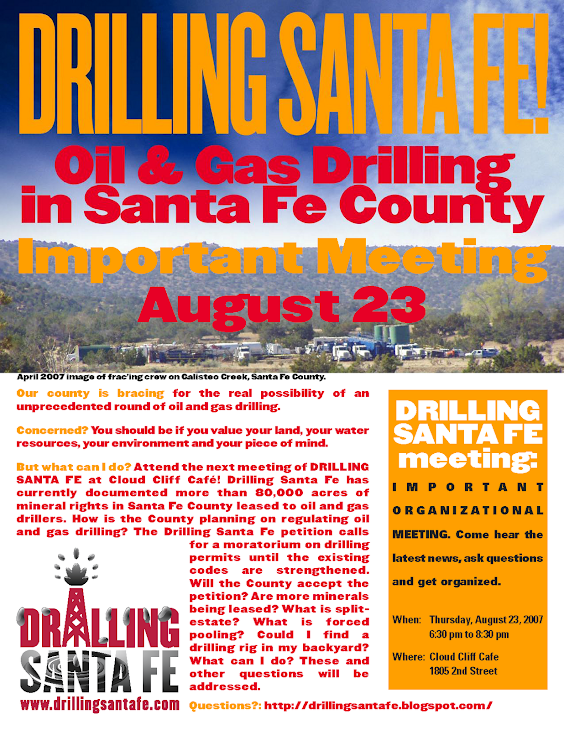
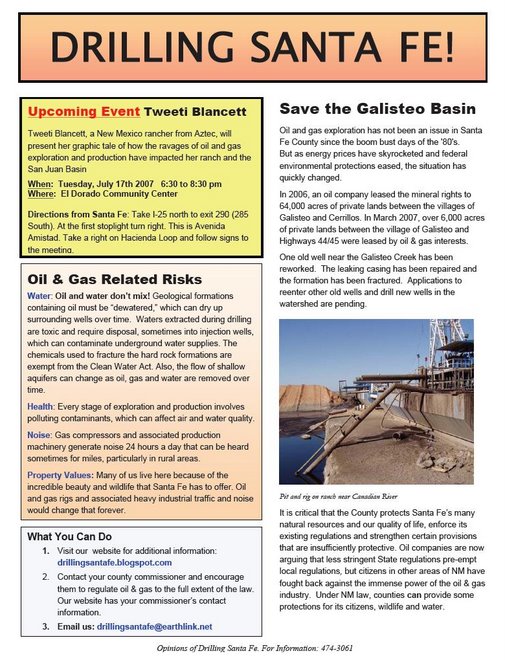
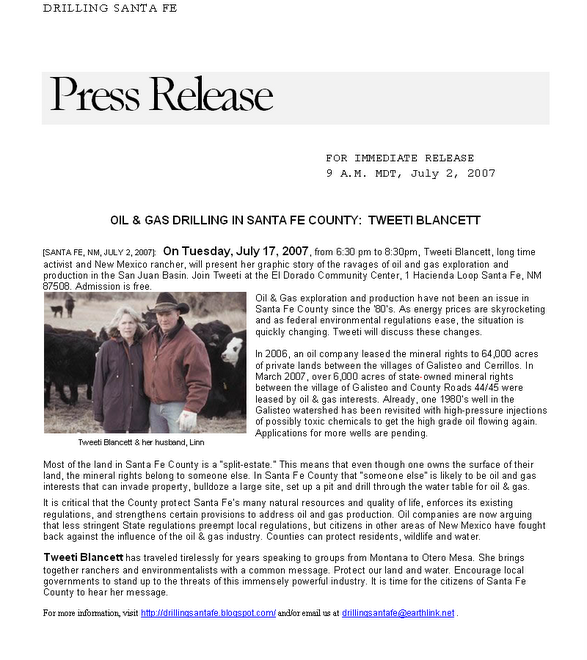
We are citizens concerned with promoting protections from resource extractive activities in Santa Fe County. Tax deductible donations [501(c)3] for DSF should be made to the Concerned Citizens of Cerrillos for the Drilling Santa Fe Fund, P.O. Box 23921, Santa Fe, NM 87502. Donations are not set up via the internet.
The mission of Drilling Santa Fe is to protect the cultural, environmental, and economic resources of Santa FeCounty from the adverse impacts of oil and gas exploration and production within the County.
Comments about SOPA (for ref. Educational Links: Surface Owners Protection Act & H.R. 2337 Ed Links)
Bob Gallagher of the New Mexico Oil and Gas Association noted that the state's landowner protection law, which just went into effect July 1, was borne out of cooperation between landowners and energy companies. The result was a balanced, fair bill that protected both sides, he said.
"It does not delay or deny access to mineral resources," Gallagher said.
Gallagher implied that the federal legislation, by contrast, is too one-sided. "It is not a good start. It is not a good finish. It was not written by someone in the field doing the work," he said.
Aside from the split-estate provisions, H.R. 2337 would amend sections of the 2005 Energy Policy Act that accelerated oil and gas drilling on public lands, severely limit the Interior Department's royalty-in-kind program and establish a fee on nonproducing leases. The measure also aims to bolster carbon sequestration studies and require new studies for wind power siting, and it would establish an intra-agency panel to address the effect of warming on federal lands, oceans and federal water infrastructure (E&E Daily, July 16).
Gable is an independent energy and environmental writer in Woodland Park, Colo
The House of Representatives will vote next week. Congressman Udall: Phone 202-225-6190 or 505-984-8950
"The Gold of the Ortiz Mountains " - William Baxter
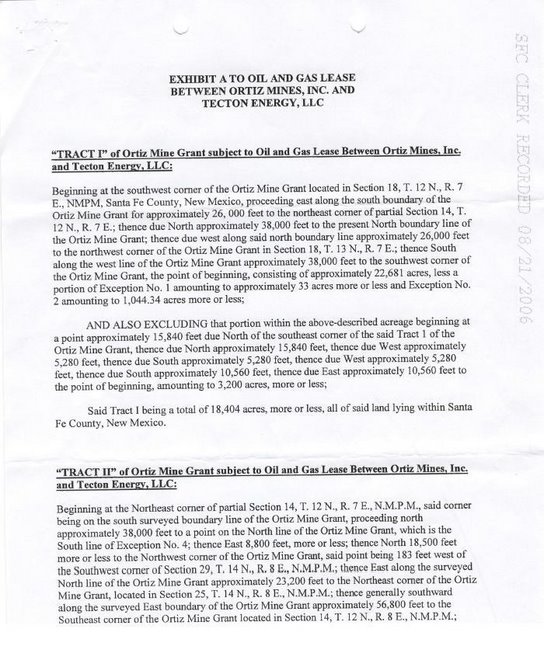
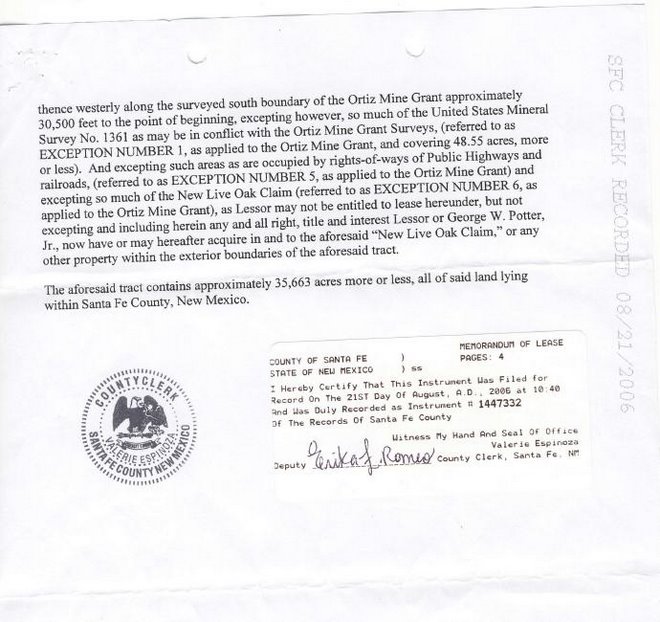
"The Gold of the Ortiz Mountains - A Story of New Mexico and The West's First Major Gold Rush," by William Baxter is not only a fascinating read, but puts the potentially impending black gold rush into context. Again, big interests have their sites set on the OrtizMountains area for mineral extraction (see memo Ortiz Mines, Inc. Memo of Oil & Gas Lease below).
Referenced Links: "Oil and Gas Exploration in Santa Fe County":
Disclaimer: All data and information provided on this site is for informational purposes only. drillingsantafe.com makes no representations as to accuracy, completeness, currentness, suitability, or validity of any information on this site and will not be liable for any errors, omissions, or delays in this information or any losses, injuries, or damages arising from its display or use. All information is provided on an as-is basis.



 Posts
Posts