Since beginning the Drilling Santa Fe blog in the Summer of 2007, it has been a very interesting journey. However, there will be a hiatus in posting. In the meantime, please use the blog as a resource.
Thank you!
Johnny Micou
Friday, March 12, 2010
Hiatus

Thursday, March 11, 2010
Will The Natural Gas Boom Undercut Renewable Energy?
Posted at Common Ground United:
By Todd Darling (about the author) Page 1 of 2 page(s)
For OpEdNews: Todd Darling - Writer
Will natural gas be the bridge fuel to the future or a road block for renewables?
No wonder the unemployed can't find work in a new Green economy: the jobs haven't arrived yet. They're stalled somewhere in Washington, DC.
Major industries have balked at making "green tech" investments, in part because Congress, the Obama administration and some national environmental organizations are now sending mixed messages.
The Los Angeles Times reports that the hesitation to invest in green technology by major industries comes because of "a lack of certainty" from Congress and the Obama Administration.(http://www.latimes.com/business/la-fi-energy-invest22-2010feb22,0,1993754.story)
Echoing this sentiment from the environmentalist side, a recent article in The Nation by Johann Hari slams big environmental groups for taking money from polluting industries and then softening their stances on a wide range of environmental legislation. Hari claims this strategy by Big Green groups like the Sierra Club has baffled followers and misdirected legislative initiatives.(http://www.thenation.com/doc/20100322/hari)
Put into earthier terms, while Congress and these mainstream environmental groups flirt with "green," they haven't yet given up on their love of fossil fuels, and the oil and gas companies are certainly spending lots of money to make sure they don't. At risk are the chances for success of a coherent national policy on renewable energy. Indeed, the positions now staked out over natural gas vividly illustrate this dilemma.
Petroleum companies are now making an aggressive push into natural gas. In doing so, they have taken on a new set of allies: big national liberal and environmental organizations. The Sierra Club's Karl Pope has recently barnstormed around the country with oil tycoon T. Boone Pickens, extolling the virtues of natural gas in public forums. They say it burns cleaner than coal, which is true, and then add, hopefully, that it will lessen our dependence on foreign oil.
On the other side, people damaged by natural gas exploration in the Mountain West feel a sharp sense of betrayal at the hijacking of the "green economy" by old school petroleum companies in cahoots with people and groups who they had previously viewed as allies. They point out that industry claims of how clean natural gas burns are overwhelmed by the problems natural gas drilling creates.
Western ranchers and landowners from Montana to New Mexico have watched their water wells dry up or become poisoned, seen their range land and natural grasses killed off, their wildlife decimated, and their formerly pristine air now subject to regular ozone alerts. http://www.1000voicesarchive.org/video/149/George-Smith-1000_Voices-Sheridan-WY
But, now the lonesome cowboys on the range have some companions in their misery. Natural gas has been discovered in large deposits in New York and Pennsylvania.
On Feb. 22, 2010, a group of activists recently disrupted the CEO of Chesapeake Energy as he delivered a lecture at Harvard entitled "Natural Gas: Fueling America's Clean Energy Future." Despite the Ivy League surroundings, the executive, Aubrey McClendon, left the event earlier than scheduled following a series of pointed questions and jeers from the audience over the impact of gas wells and "hydraulic fracturing" atop the clean drinking water supply for New York and Pennsylvania. Most significantly, this event and the surrounding growth of local grass-roots opposition indicate how a bitter conflict from the sparsely populated West has now moved into the more densely populated East.
The oil industry is staking a lot of money on natural gas. Exxon Mobile recently announced intentions to a buy natural gas company, XTO for $29 billion. Exxon wants XTO's extensive leases on the natural gas deposits under the Marcellus Shale in up-state New York and Pennsylvania. Since natural gas burns cleaner than coal or conventional gas Exxon may see this as an opportunity to earn both money and "green" credentials without having to change its core business. Enabling such a view, environmental groups such as the Sierra Club and the Environmental Defense Fund, along with Democrats like Colorado's former US Senator, Tim Wirth, back natural gas as a "bridge fuel" - an alternative to coal.
But this "bridge" could lead to brand new environmental hazards that cannot be derided as minor NIMBY (Not In My Backyard) aggravations.
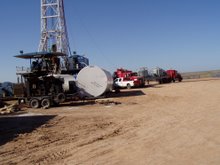
Here's why: Traditionally, natural gas comes up a well from a pool below the surface. However, the gas reserves now pursued by Exxon and others are trapped in shale rock, coal deposits, and other tricky geological structures making extraction more difficult.
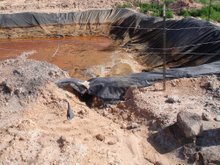
How to get gas out of shale? Blast it with an ocean of chemically laced water. This method called "hydraulic fracturing" has been developed to get this gas out of shale and "tight sands." This method carries enormous hazard, and proceeds with little or no oversight. The drillers say they carefully cap the well so the chemicals don't come back up. But, the trouble is, according to the Powder River Basin Resource Council in Wyoming (www.powderriverbasin.org), the chemically laced water blasted down the well doesn't stop moving once the gas comes up. The chemical cocktail keeps migrating.
 1 | 2
1 | 2
Todd Darling is a Los Angeles based filmmaker. His documentary "A Snow Mobile for George" looks at the impact of environmental de-regulation upon individuals. Shot during a cross-country trip, the film tells the stories of Yurok salmon fishermen (more...)
The views expressed in this article are the sole responsibility of the author
and do not necessarily reflect those of this website or its editors.
 Contact Author Contact Author | Contact Editor |  View Authors' Articles View Authors' Articles |
Wednesday, March 10, 2010
Dallas-Fort Worth earthquakes coincident with activity associated with natural gas production
The below research study is now posted at Common Ground United under Drilling Education:
Dallas-Fort Worth earthquakes coincident with activity associated with natural gas production
Research from SMU and UT at Austin reveals that the operation of a saltwater injection disposal well in the area was a "plausible cause" for the series of small earthquakes that occurred in the area between Oct. 30, 2008, and May 16, 2009.
Drilling Education Link>>>>
Press Release Link>>>>
Report Link (pdf) >>>>
Dallas-Fort Worth earthquakes coincident with activity associated with natural gas production
Research from SMU and UT at Austin reveals that the operation of a saltwater injection disposal well in the area was a "plausible cause" for the series of small earthquakes that occurred in the area between Oct. 30, 2008, and May 16, 2009.
Drilling Education Link>>>>
Press Release Link>>>>
Report Link (pdf) >>>>
Obama aide urges listing of gas-drilling chemicals
"Joseph Aldy, special assistant to the president for energy and the environment, said concerns about water contamination from drilling chemicals could lead to states requiring disclosure and that could deter additional investment.
“You can’t leave this in the status quo if you think we are going to have significant shale gas development in the United States,” Aldy told Reuters after a natural gas conference.
Some energy companies decline to publish lists of toxic chemicals used in hydraulic fracturing, a technique used to extract natural gas from shale beds far underground.
Companies have been under pressure from critics of fracturing and from some lawmakers, who say the technique is damaging the water supplies of people who live near gas rigs." More>>>>
Sunday, March 7, 2010
S.F. County draft plan negatively impacts public
Santa Fe New Mexican
Ross Lockridge III
Posted: Saturday, March 06, 2010
Opinion
"Is the built-in ease of initiating amendment of Santa Fe County's new "constitution" likely to make it more like ... Swiss cheese?
David Henkel is right. ("Professor urges locals to speak up on development" (Feb. 19). The development of the new draft county plan is taking into account the singularity of Santa Fe County — a big plus. But he also notes that there are ambiguities in the language that could limit timely, effective participation for public review of proposed amendments. But problems concerning amendments step beyond language ambiguities.
The draft plan calls for combining development applications with applications to amend the county plan (and code).
This combination would, however, be an invitation to a developer to amend the county plan rather than to meet the parameters of the plan itself. Consequently, the ability to combine such applications would remove incentive to comply with the existing general or community plans/codes. Note that an applicant or "owner" can be a lessee of subsurface rights, corporations, or trusts, etc.
The current county code allows consideration of amendments of the general plan or code predictably on a yearly basis. In the new draft plan and code, amendments could be applied for or initiated at any time by either an applicant, planning commission, board of commissioners or code administrator.
Attorney Robert Freilich, last year while submitting part of the draft code, announced: "You (the CDRC/planning commission would) have the power to initiate amendments to the general plan, to the zoning text, to the districts; you can initiate them on your own." He continued, "You, or the Board (county commission) or the administrator can initiate legislation for changes to the code at any time."
An ability to initiate amendments to the plan at any time could also be subject to political abuse. What if a commissioner was pressed to back a corporation's desire to start a development, say a mining operation in his/her district, in an area where the community had planned restrictions in the code on such zoning?
Under the draft Sustainable Land Development Plan, that county official could then at any time attempt to initiate actions that could destabilize and undermine that community, its plan and code. We need the plan to reflect public intentions and protect the county, at all levels, from the appearance of unethical actions.
Clearly it's not only that more time is needed to review applications. What Freilich and the county attorney's office would set up could overwhelm the public's ability to defend the "constitution," their community plans and ordinances from multiple and unpredictable amendment initiations.
On the one hand, the plan calls for predictability, but only for the applicants. When looked at from the citizens' view, the deregulatory nature of the draft is unpredictable.
Although there may conceivably be narrowly defined paths in an application process where concurrent development and plan amendment applications could be directed, the proposed wide avenue of such concurrency is spread with peril.
Consideration of alternatives is needed for processing development applications effectively, fairly. Such "at any time" amendments along with fast-track concurrent development amendment applications would skew favor from the public interest, have unintended consequences, and would undermine stability of the plan.
Best to keep the plan clear and unambiguous. In order to preserve constitutional stability, the county needs to reserve amendments for predictable, yearly review as the current code directs.
Ross Lockridge is a longtime resident of Cerrillos, who has helped in local planning efforts. He is currently involved in the Santa Fe County public participation workshops for the Sustainable Land Development Plan. "
Link>>>>
Colorado's gas industry following trend in the United States
Herald Denver Bureau
"National decline followed prices A chart of drilling rig numbers in Colorado looks a lot like the national numbers. And both charts closely track the price of natural gas. There's a spike in 2008, followed by a steep drop and now a recovery.
Alaska State Sen. Hollis French made the same point when defending his state's oil taxes at a hearing against critics who blamed the industry's decline on high taxes.
“It just happened to start two years ago, when we passed (the oil tax)," said French, a Democrat who is running for governor. “I think we need to be cautious about drawing too many conclusions when we see this kind of drop across the nation."
A similar situation happened in New Mexico, which adopted tougher rules for gas and oil waste pits about the time Colorado was passing its environmental rules.
The state's industry didn't fall until national prices crashed, said Jodi McGinnis Porter, a spokeswoman for the Energy, Minerals and Natural Resources Department.
“What we've noticed is everything correlates to price. The price of gas peaked in the summer of 2008," Porter said. “Drilling was going nuts."
Pa., La. lead the pack It's going nuts again in Pennsylvania, Louisiana and a few other states." More>>>>
Sunday, February 28, 2010
Governor's pollution bills fall short
Susan Montoya Bryan | The Associated Press
Posted: Saturday, February 27, 2010
"Gov. Bill Richardson's 30-day legislative session didn't go exactly as planned.
With the end of his second four-year term looming, this was his last chance to push through the New Mexico Legislature an environmental agenda aimed at cracking down on polluters and the emissions blamed for global warming.
Lawmakers didn't play along.
"It's disappointing," said Sarah Cottrell, the governor's energy adviser.
Richardson wanted to give state regulators the power to deny new permits or revoke existing permits after a track record of air quality violations. State laws that govern water, solid waste and hazardous materials already include a so-called bad actor clause, but the air quality act does not.
The Democrat governor also took aim at greenhouse gas emissions with legislation that would have established the groundwork for a future cap-and-trade program.
The measure would have allowed the Environmental Improvement Board, an unelected body appointed by the governor, to establish rules for early reduction credits, offsets and the reporting of greenhouse gas emissions for electricity imported to New Mexico.
The bad actor bill failed by a single vote, and the emissions measure languished in committee after drawing fierce opposition from an army of lobbyists, utilities, small-business owners, agricultural interests and some residents.
The Senate also rejected one of Richardson's nominees to the Environmental Improvement Board.
However, the governor has said his administration will not abandon plans for adopting environmentally friendly policies.
"For those who think I am going to retreat from protecting the environment, clean air ... they are mistaken," Richardson said at a Feb. 16 news conference.
It's up for debate whether the measures failed because lawmakers were overwhelmed with the state's budget crisis or because they were concerned about giving more power to the executive branch.
Rep. Brian Egolf, a Santa Fe Democrat who sits on the House Energy and Natural Resources Committee, chalked it up to politics.
"I think the Republicans are focusing on a boogeyman of convenience, and that's the Environmental Improvement Board. They are using that as an excuse to derail some stuff that's pretty commonsense and pretty important for regular folks," Egolf said. " More>>>>
Saturday, February 27, 2010
Hearing to look into gas emissions
Updated: Friday, 26 Feb 2010, 11:11 PM MST
Published : Friday, 26 Feb 2010, 11:11 PM MST
"SANTA FE (KRQE) - On Monday, the New Mexico Environmental Improvement Board will hold a public hearing on a petition to reduce the level of greenhouse gas emissions in New Mexico to 25 percent below 1990 levels by 2020 and it could impact just about every New Mexican.
To turn on the lights, many New Mexicans depend on coal fired electric plants. The San Juan generating plant in Waterflow, N.M. generates most of PNM’s electricity, but like all coal fired plants it also generates pollution.
“We're at a crossroads where we can continue going down the path we've been on, or we can chart a new direction for energy in the state,” family practice physician John Fogarty said.
Fogarty is the President of New Energy Economy, a Santa Fe based non-profit organization petitioning the state Environmental Improvement Board to cap those greenhouse gas emissions.
“It's a really important time where congress is failing to act and it's incumbent on states to step up to the plate and address this really critical issue that is going to affect our children and future generations,” Fogarty said.
He believes the change, capping carbon emissions, will help the state's economy by unleashing capital investment in alternative energy.
“This is just a devastating regulatory action,” Jason Sandel said.
Sandel runs Aztec Well Servicing, a company that drills for natural gas and services the equipment.
“It's essentially regulations gone wild,” he said."' More>>>>
Friday, February 26, 2010
Land Swap Tension Rises Lyons Faces Off With Opposition
The New Mexico State Land Office (SLO) headed by Pat Lyons has yet another controversy besides leasing State lands/minerals in fragile ecosystems of frontier areas such as the Las Vegas Basin for exploratory drilling or "wildcatting," the White Peak land swap issue has become another hot topic.
Albuquerque Journal North
Friday, February 26, 2010
Journal Staff Writer
"The heat generated over some White Peak land swaps was dialed up another notch Thursday with developments on three fronts.
Albuquerque Journal North
Friday, February 26, 2010
Journal Staff Writer
"The heat generated over some White Peak land swaps was dialed up another notch Thursday with developments on three fronts.
- The State Land Office claimed that the Attorney General's Office is trying to limit the land commissioner's legal discretion and authority in challenging the land deal. This contention came in a response to an Attorney General petition in the New Mexico Supreme Court attempting to block the land exchanges.
- Land Commissioner Patrick Lyons faced the New Mexico State Game Commission and "war-painted" hunters vehemently opposed to the deal.
- The League of United Latin American Citizens filed a brief in support of the Attorney General's efforts in the Supreme Court, raising the issue of historic land grants given to Spanish settlers. " More>>>>
Related post:
Amid strife, first Whites Peak land swap closes
Drilling Could Threaten Drinking Water
 However, the drilling technique used to unlock the gas, called hydraulic fracturing, or "fracking," has become a serious point of contention.
Pioneered by Halliburton in the 1940s, fracking is a common process used by oil and gas companies to retrieve tough-to-get reserves. Much like bubbles in carbonated soda, natural gas exists in bubbles deep underground. Getting to these pockets involves injecting millions of gallons of water, sand, and chemicals into the ground to crack open these bubbles, allowing the gas or oil to flow to the surface.
While drilling companies are not required to disclose exactly what chemicals they use, experts agree that benzene, formaldehyde, methanol, and xylene, among others, are some of the most commonly used. All of these substances are toxic in water at very low levels.
Although fracking is the most efficient and widespread drilling method, used in about 90 percent of U.S. oil and gas wells, environmentalists and health advocates have raised concerns about potential health risks associated with the chemicals used in fracking.
According to a report released in November 2009 by Environment Texas, a research and policy group, gas drilling can pollute and sometimes poison clean water sources.
"Fluid that is left behind (some studies estimate that 91 percent of injected fluid never returns to the surface) after the fracking process could find its way to drinking water," the report says, "and drilling into these formations can create pathways by which fluids or natural gas itself can find its way into water supplies."
The protests of advocacy groups and concerned citizens have sparked a national debate.
Does oil and well drilling contaminate drinking water?
People living near drilling facilities in states like Pennsylvania, Colorado, New Mexico, and Wyoming seem to think the answer is yes." More>>>>
See related posts:
"Oil and gas well drilling does not taint drinking water"-- Really?
Congress to Investigate Safety of Natural Gas Drilling Practice Known as Hydraulic Fracturing
Wednesday, February 24, 2010
Sharon Wilson (aka, TXsharon) at Bluedaze to Head Texas Oil & Gas Accountability Project

Congratulations to Sharon Wilson (aka, TXsharon) of the stellar blog, Bluedaze, to head the newly formed Texas Oil & Gas Accountability Project.
From Bluedaze:
From Bluedaze:
Texas Oil & Gas Accountability Project Launches,
Releases Oil & Gas Development Best Practices Platform
EARTHWORKS formally launched its Texas Oil & Gas Accountability Project (OGAP) via telephone conference on today at 1:00 p.m. Central Standard Time. At the launch, Texas OGAP will release its campaign platform, DRILL-RIGHT TEXAS: Best Oil & Gas Development Practices for Texas. We will also introduce the lead Texas OGAP Organizer, Sharon Wilson, along with other key experts on the impacts of oil and gas development on health, communities and the environment. The new EARTHWORKS campaign will work throughout Texas to prevent and minimize the impacts caused by energy development.
EARTHWORKS' nationally-recognized Oil & Gas Accountability Project was created in 1999 to work with communities to prevent and reduce the impacts caused by energy development. In its first decade, OGAP boldly challenged the notion that natural gas is clean energy by exposing the industry practice of hydraulic fracturing, the widespread use of toxic drilling chemicals and the oil and gas industry's sweeping exemptions from U.S. environmental laws. OGAP has built a national network of diverse organizations addressing drilling issues and has pushed for the passage of precedent-setting laws and regulations protecting landowner rights, special places and public health from Alaska to New Mexico and beyond. OGAP's 2005 publication, Oil and Gas at Your Door? A Landowner's Guide to Oil and Gas Development, is considered the preeminent resource for landowners and communities facing drilling in their backyards.
EARTHWORKS staff and board members have worked with Texans since the Barnett Shale drilling boom sparked citizens to demand greater oversight of oil and gas activities in the region. For the past year, we've been coordinating with a volunteer steering committee of rural and urban residents to form Texas OGAP and develop DRILL-RIGHT TEXAS.
Working with concerned Texas citizens, Wilma Subra, a chemist and MacArthur Genius Award recipient, who is also a board member of EARTHWORKS, recently conducted a health survey in DISH, Texas, and presented the results to the DISH Town Board and Texas Commission on Environmental Quality (TCEQ): http://www.earthworksaction.org/publications.cfm?pubID=439. This work has already resulted in a new TCEQ same-day response policy to odor complaints from oil and gas facilities. Citizen pressure has also successfully persuaded the agency to begun air quality monitoring in the Fort Worth region, where over 1,100 wells have been drilled within city limits.
Texas OGAP will work with communities statewide to prevent and minimize the impacts caused by energy development. EARTHWORKS has 27,000 members nationwide, and maintains offices in California, Colorado, Montana, New Mexico, Texas and Washington, D.C.
Watch for more information. "
New Group to Watchdog Texas Drilling Industry
A New Watchdog for Texas' Shale Gas Drilling Industry
Is gas drilling waste radioactive?
Part I in a series
by Sharon Corderman
Free Press-Courier
'“It is especially important to understand the potential radioactivity of wastes that may be disposed of in areas that are located close to residences or public facilities such as schools,” wrote Lisa Sumi in a May 2008 report prepared for the Oil & Gas Accountability Project. “For example,” she continued, “during drilling, there may be a large volume of radioactive Marcellus shale rock removed (in other words, the drill cuttings), especially from horizontally drilled wells. If these rock wastes are disposed of by on-site burial or land-spreading, the radioactivity may become an issue for those living nearby. Radioactive wastes should be taken to a facility that is designed to handle low-level radioactive waste.” ' More>>>>
Tuesday, February 23, 2010
(NM Leg.) Special session delayed until Monday
Associated Press - February 23, 2010 4:25 PM ET
"SANTA FE, N.M. (AP) - Gov. Bill Richardson says he has pushed the start of a special legislative session back until Monday.
The governor says he had requests from House and Senate leaders for more time to negotiate spending cuts and tax increases before they resume debate over a state budget.
Richardson says he feels the state needs a budget sooner than later despite concerns by some lawmakers about waiting for updated revenue projections.
Democrat Sen. John Arthur Smith of Deming says he believes New Mexico's revenue growth will be half of the projected 6 percent lawmakers assumed when hammering out a failed budget proposal during the regular session.
The special session was to have begun Wednesday.
Copyright 2010 The Associated Press. All rights reserved. This material may not be published, broadcast, rewritten or redistributed."
Sierra Club v. Sierra Club: "Natural Gas As A Climate Fix Sparks Friction"
February 23, 2010
"Some local chapters of environmental groups find themselves battling their national leadership over issues like natural gas. The national groups see natural gas as a less-harmful alternative to coal. But local groups fear the damage that gas production could bring to their fresh water and landscapes."
See related post:
Environmentalists debate whether natural gas is safer for the environment
Congress to Investigate Safety of Natural Gas Drilling Practice Known as Hydraulic Fracturing

"The top Democrats on the House Committee on Energy and Commerce have asked eight oil-field companies to disclose the chemicals they’ve used and the wells they’ve drilled in over the past four years. Last week, Waxman also revealed two of the largest gas drilling companies have pumped hundreds of thousands of gallons of diesel-based fluids into the ground in violation of a voluntary agreement with the Environmental Protection Agency. [includes rush transcript]
Guests:
Josh Fox, director of GasLand. Won Special Jury Prize for Documentary at the Sundance Film Festival. In GasLand, Josh Fox travels across the United States to meet people whose lives have been impacted by natural gas drilling.
Lisa Bracken, lives on a wildlife sanctuary near Divide Creek in Colorado. Divide Creek suffered environmental damage in a blowout cause by natural gas drilling. She appears in GasLand.
Joe Levine, co-founder of the groups Damascus Citizens for Sustainability and NY-H2O, which oppose the gas drilling.
Rush Transcript
This transcript is available free of charge. However, donations help us provide closed captioning for the deaf and hard of hearing on our TV broadcast. Thank you for your generous contribution.
Donate - $25, $50, $100, More..."
Monday, February 22, 2010
NMELC: GHG Emission Case Gets Attention
New Mexico Environmental Law Center
"On January 13, 2010, PNM, El Paso Electric Co., the NM Oil and Gas Assoc., five additional statewide trade groups and three state legislators filed a lawsuit in state district court in Lovington against the NM Environmental Improvement Board (EIB). The suit attempts to prevent the Board, an executive agency, from evaluating the greenhouse gas petition that we submitted on behalf of New Energy Economy in 2008.
"PNM and its allies would rather throw money at lawyers and publicists than work in good faith towards reducing
For the past year, PNM and its co-plaintiffs have been working furiously to defeat our petition. Here's why: our client wants
An EIB hearing to collect public comments will be held on March 1 in
Your input is important! But check back with our website before March 1, in case the Lovington judge puts a hold on the hearing...
- Shelbie Knox, Development Officer
Get more info and filed documents on the Greenhouse Gas Emission Caps case"
Sunday, February 21, 2010
Film (Split Estate) explores drilling's hidden impact
Veronica M. Cruz | The New Mexican
Posted: Saturday, February 20, 2010
"It's been nearly two years since Tecton Energy abandoned its plans to drill in the Galisteo Basin. But for communities in the Rocky Mountain region and several other states around the country, the battle between landowners and natural gas and oil companies is far from over.
In the documentary Split Estate, producer/director Debra Anderson, who lives in Santa Fe, focuses on the detrimental effects of the controversial deals that she says can wreak havoc on the environment and pose health threats to people in areas where drilling occurs.
"It was somewhat invisible because a lot of the big drilling is happening in big, unpopulated places," said Anderson in a telephone interview. "Then they started to creep into residential areas. A lot of people I talked to had been trying to get attention to this issue for a while."
Her film, which took three years to complete, focuses on the San Juan Basin in Northern New Mexico and Garfield County, Colo., and is narrated by fellow Santa Fean Ali McGraw." More>>>>
~~~~~
IF YOU GO
What: Screening of Split Estate
When: 8 p.m. Friday
Where: Center for Contemporary Arts, 1050 Old Pecos Trail
Cost: $9.50; seniors, students and military, $8.50
For more information: www.splitestate.com
What: Screening of Split Estate
When: 8 p.m. Friday
Where: Center for Contemporary Arts, 1050 Old Pecos Trail
Cost: $9.50; seniors, students and military, $8.50
For more information: www.splitestate.com
Saturday, February 20, 2010
"Oil and gas well drilling does not taint drinking water"-- Really?
By Other Voices
February 20, 2010, 3:48AM
Oil and gas industry advocate letter:
"Michael Scott's article Sunday ("Family says gas well tainted its water, but state disagrees" poses a simple, straightforward question: "Does oil and gas well drilling really threaten our drinking water?"
The simple and straightforward answer is this: It does not. And while Scott references an exhaustive 2004 Environmental Protection Agency report that confirmed that fracturing does not threaten groundwater, Plain Dealer readers should also be aware that earlier this week, a top EPA drinking-water official stated the same thing -- suggesting further that states, and not the federal government, are best positioned to regulate this critical technology in a way that balances the imperative of responsible energy exploration with the safeguarding of our environment.
As for the claims made by some that the fracturing process requires "diesel fuel" to be injected underground, the reality is actually quite the opposite. The fluids used in the process are made of 99.5 percent water and sand -- with the slight remainder comprised of household materials you're just as likely to find in the kitchen cupboard and beneath the kitchen sink. As for that diesel fuel -- sure, the trucks may run on it, but you won't find it anywhere else.
Lee Fuller, Washington, D.C.
Fuller is executive director of Energy In Depth, a coalition of independent gas producers (energyindepth.org)."
~~~~~
Hmmm.
What about this letter posted at OGAP (Oil & Gas Accountability Project)?
LETTER TEXT:
"October 8th, 2004
Weston Wilson
EPA Employee
Denver, Colorado
Honorable Wayne Allard
7340 E. Caley, Suite 215
Englewood, Colorado 80111
Honorable Ben Nighthorse Campbell
6950 E. Belleview Avenue, Suite 200
Greenwood Village, Colorado 80111
Honorable Diana DeGette
600 Grant Street, Suite 202
Denver, Colorado 80203
Dear Senators Allard and Campbell and Representative DeGette,
Recent events at EPA have caused me and several of my peers at EPA great concern. In June of this year, EPA produced a final report pursuant to the Safe Drinking Water Act that I believe is scientifically unsound and contrary to the purposes of the law. In this report, EPA was to have studied the environmental effects that might result from the injection of toxic fluids used to hydraulically fracture coal beds to produce natural gas. In Colorado, coal beds that produce natural gas occur within aquifers that are used for drinking water supplies. While EPA's report concludes this practice poses little or no threat to underground sources of drinking water, based on the available science and literature, EPA's conclusions are unsupportable. EPA has conducted limited research reaching the unsupported conclusion that this industry practice needs no further study at this time. EPA decisions were supported by a Peer Review Panel; however five of the seven members of this panel appear to have conflicts-of-interest and may benefit from EPA's decision not to conduct further investigation or impose regulatory conditions.
As these matters are complex, I enclose a technical analysis to further inform you and other members of Congress. I invoke the protections under the First Amendment of the Constitution and the Whistleblowers Protection Act should EPA retaliate against me as a result of speaking with you or other members of Congress or speaking to the press or the public regarding this matter. i am a resident of Denver in the first Congressional District of Colorado and I am employed by the Environmental Protection Agency in Denver. I have been employed by the EPA's Regional Office in Denver, since 1974. I am currently assigned to the Office of Ecosystems Protection and Remediation, National Environmental Policy Act (NEPAl Team, I am an environmental engineer assigned to assist EPA with its responsibilities under Section 309 of the Clean Air Act to independently review federal agency's compliance with NEPA. Currently I analyze the environmental impacts of coal mining, gold mining, and oil and gas development on public lands. I serve as the Legislative Advocate for the American Federation of Government Employees Local 3607 representing professional and non-professional employees in EPA Region 8. I have also served as the President of Local 3607 in the past. EPA's failure to regulate the injection of fluids for hydraulic fracturing of coal bed methane reservoirs appears to be improper under the Safe Drinking Water Act and may result in danger to public health and safety. I respectfully request that you investigate this matter and respond as you and other members of Congress deem appropriate.
Red Rock Pictures and New Energy Economy Present Split Estate at CCA on Friday, February 26 at 8 pm
Press Release:
"Red Rock Pictures and New Energy Economy Present Split Estate at CCA on Friday, February 26 at 8 pm
Red Rock Pictures is joining forces with New Energy Economy to help move New Mexico to the forefront of clean energy development and visionary climate change action. The two organizations will present a screening of Split Estate at the Center for Contemporary Arts, 1050 Old Pecos Trail, on Friday, February 26 at 8 pm. For more information and/or to order tickets, please call the CCA box office at 505.982.1338.
The joint production will raise awareness of an upcoming opportunity to cap the state's global warming emissions and establish New Mexico in a leadership role in addressing climate change. New Energy Economy, dedicated to energy independence and creating opportunities for New Mexico by developing solutions to global warming, has petitioned the state's Environmental Improvement Board (EIB) to set a science-based cap on carbon emissions in New Mexico.
On March 1, the EIB will hold public hearings at the Toney Anaya Building, located at 2550 Cerrillos Road in Santa Fe. This is a critical opportunity to stand with fellow citizens and speak for New Mexico's future.
Narrated by Ali MacGraw, Split Estate is an award-winning documentary film that maps a tragedy in the making, as citizens in the path of a natural gas drilling boom in the Rocky Mountain West struggle against the erosion of their civil liberties, their communities and their health.
"Split Estate tells a powerful story about Americans living with the dirty side of oil and gas development in their own backyards," states Amy Mall, Senior Policy Analyst with the Natural Resources Defense Council.
The film, which makes a compelling case for clean energy development, was used as an educational tool by a grassroots coalition in Santa Fe County to help establish one of the strongest ordinances in the country to safeguard against irresponsible development and production by the fossil fuel industry.
Director Debra Anderson will be on hand, as will be the staff of New Energy Economy to discuss their petition before the EIB.
For tickets to the February 26 screening, please call 505.982.1338.
For more information about Split Estate: www.splitestate.com
For more information about the March 1 public hearing, please contact Ryan Shaening Pokrasso with New Energy Economy at rshaenin (at) gmail.com and 831.566.9387."
Professor urges locals to speak up on development
Public input welcome at twice-weekly workshops for sustainable land plans
Phaedra Haywood | The New Mexican
Posted: Friday, February 19, 2010 - 2
"Planning may not be intriguing, but planning professor David Henkel has a warning for Santa Fe County residents: "If you don't plan, someone else is going to make decisions that you can't control and you may not like them."
Henkel is one of about 20 county residents providing public input at twice-weekly workshops designed to usher Santa Fe County's draft Sustainable Land Development Plan or SLDP, toward adoption.
Henkel has lived in the Galisteo Basin area since 1987. He teaches planning at The University of New Mexico's School of Architecture and Planning and has spent the last 10 years working with his students conducting environmental research in southern Santa Fe County. He helped the communities of Lamy, Eldorado, Galisteo, Cerrillos and Santo Domingo Pueblo develop their own community plans and participated in the last two plan rewrites for Santa Fe County.
He said the SLDP is a more evolved version of the plans penned in the past two decades.
"In the early '80s, the key factor was water," Henkel said. The update in the early '90s kept the focus on water, but added in a consideration of planning for infrastructure and services, he said.
Henkel said the new plan considers more factors, including the health of the land, water and the economy.
What's most different about it, Henkel said, is that it takes into account the singularity of Santa Fe County. " More>>>>
Revised Sustainable Land Development Plan (SLDP)>>>>
Thursday, February 18, 2010
San Miguel County Oil & Gas Ordinance Task Force

San Miguel County
Oil & Gas Ordinance Task Force
212 Mills AveLas Vegas, NM
Wednesday, February 17, 2010
(NM) Senate rejects environmental board pick
"Old wounds among Democratic state senators helped sink Gov. Bill Richardson's nominee to an environmental board on Tuesday.
The Senate voted 17-25 to reject the nomination of Neri Holguin to the state Environmental Improvement Board. It was the first time since 1997 that the Senate rejected a governor's nomination.
Ten Democrats joined all 15 Republicans to scuttle the selection of Holguin, who has served on the board for about seven months. The board sets rules and regulations for the state Environment Department.
Holguin is a professional Democratic political consultant who ran the campaigns of at least three current senators and helped on the campaign of at least one other.
Her work in campaigns was one reason cited by some of those who voted against her.
The board has drawn criticism recently from some legislators and business organizations who object to the panel trying to regulate greenhouse gases emissions.
But most of the sparks that flew had to do with Holguin's campaign work. The vote dramatized the split between more conservative members, who opposed the nomination, and the progressive wing, which backed her." More>>>>
Monday, February 15, 2010
House defeats pollution provision bill (HB 259)
Feb. 15th, 2010
"A proposal that would give private citizens the power to go after polluters who violate certain New Mexico environmental laws has been rejected by the House.
The legislation would have amended the Environmental Improvement Act, the Water Quality Act and the Oil and Gas Act to allow for a person to go to court to demand that polluters comply with state laws spelled out by the three acts.
The measure also would allow citizens to file civil actions against state agencies if they fail to enforce the laws.
The House defeated the measure on a 34-32 vote over the objections of lawmakers who argued the proposal would open the door to frivolous lawsuits.
Critics also were concerned that environmental groups would be able to bring suits under the proposal."
HB 259 to be heard by the House
Update: HB 259 Support the private right to enforce environmental statutes
Sunday, February 14, 2010
EARTHWORKS: Good news for New Mexico and drilling affected communities across the country (HB 259 +)
Good news for New Mexico and drilling affected communities across the country
Polluter stopping bill moves ahead
Yesterday a bill that would allow citizens to enforce environmental laws -- to stop polluters from polluting -- took a big step towards becoming law.
The New Mexico House Judiciary Committee passed Private Action to Enforce Environmental Statute - House Bill 259.
It goes to the House floor this afternoon; then it's on to the Senate. If it passes the whole legislature, the Governor will certainly sign it into law.
And more good news.
The New Mexico legislature also killed a ridiculous proposal by drilling industry champions. Industry wanted to punish communities who regulated oil & gas drilling by prohibiting them from receiving taxes generated by drilling. Only if a community let industry run wild would they get severance tax revenue. Fortunately, that proposal died (was tabled) a well deserved death this week.
This is a big deal nationwide because New Mexico is a bellwether for the entire country. Good drilling laws and regulations in New Mexico will influence other states wrestling with similar issues -- like New York and Pennsylvania.
Thanks to everyone that made calls and donated to help counter industry's initiatives.
Stay tuned for more updates. Things are looking good, but the fight is not over until this common sense bill becomes law.
Thanks,
Gwen Lachelt, Oil & Gas Accountability Project Director
EARTHWORKS
Saturday, February 13, 2010
HB 259 to be heard by the House
HB 259 has moved from the House Judiciary Committee and will go onto the House floor tonight.
See post:
Update: HB 259 Support the private right to enforce environmental statutes
Subscribe to:
Posts (Atom)

 Posts
Posts