Friday, August 8, 2008

Santa Fe County Development Review Committee Special Meeting

Click here for CDRC Meeting Minutes and Agendas page »

Texas residents want gas drilling permits stopped


"Pipelines carry their own risks as demonstrated by this Palo Pinto County explosion in 2005. As pipelines age they fail. Should they be in residential neighborhoods?" (File Photo: The Fort Worth Coalition for a Reformed Drilling Ordinance (CREDO))

Posted at Common Ground United from msn money/Associated Press:

"FORT WORTH, Texas (AP) - Holding "Just say, Whoa!" signs, about 300 people rallied Thursday to urge Fort Worth leaders to stop natural gas drilling permits and pipeline easements in the city...."

"...We expect the city to put a moratorium for as long as it takes to address these issues," said Cathy Hirt, a former City Council member who helped form the Coalition for a Reformed Drilling Ordinance. "With such a large, diverse group of people here from all walks of life, it speaks to the fact that this is not a small group of naysayers — it's a cross-section of the community who have a lot of concerns...."

"...They are also concerned about companies using eminent domain to acquire property for pipeline easements.

Last week Chesapeake Energy's subsidiary, Texas Midstream Gas Services, started condemnation proceedings against a 72-year-old woman who refused the company's offer of nearly $13,000 for a 20-foot strip across the front of her 100-foot-wide lot.

The pipeline, which would be 10 to 20 feet underground and connect two well sites along an interstate, requires easements under the front yards of nearly 50 homes and vacant lots." More>>>>

Related Story: "Urban Gas Drilling Causes Backlash In Boomtown "

"Chesapeake Energy's CEO, Aubrey McClendon, is a big believer in aggressive media campaigns. He was a major backer of the Swift Boat Veterans for Truth, the group that attacked Massachusetts Sen. John Kerry's military record when he ran for president in 2004, and other right-wing causes.

The comany's stock market value tops $28 billion, and last year McClendon's compensation and stock options totaled nearly $19 million.

In the wake of Chesapeake's infomercial comes Shale TV, a daily talk show about the Barnett Shale set to air this fall. The company has hired three award-winning Dallas broadcast journalists to produce the show.

Julie Wilson, Chesapeake vice president for corporate development, says she understands there's skepticism about the objectivity of Shale TV, but she insists it's no different than the rest of corporate media.

"Well, I think we pay those journalists — whether on Channel 8 or Channel 11 or the Star-Telegram — in terms of advertising support," Wilson says. "We see this as pretty much instead of running the ads on the program, we're just writing the check direct."' More>>>>

ShameonBigOil.org


Posted at Common Ground United is a The Huffington Post post, "Big Oil Big on Profits, Small on American Values," that opens with "Sometimes I forget that the big oil companies are not really American companies. Sure, many of them are incorporated in the USA, but face it, these are multinational corporations, each bigger than many countries (economically, of course ... the 68 million acres they already have are only leased, not owned). So I really shouldn't be surprised that at a time when oil prices are so high and hard-working American families are trying to make ends meet, the big oil companies are sucking down some pretty obscene profits." The article then references Shame on Big Oil. From the site shameonbigoil.org:

"Big Oil is serious about one thing- they want to keep us addicted to gas. What we really need are solutions that help reduce our dependence on oil. This includes better mass transit, more fuel efficient cars, and more alternative energy sources, to name a few. It’s time for our elected leaders to say NO to Big Oil and say YES to real solutions that help consumers and protect our last open spaces."

Thursday, August 7, 2008

"The Challenges of Unconventional Oil & Natural Gas"

Thanks to Environmental News for New Mexicans for informing us about the upcoming event, " in Santa Fe, New Mexico, Nov. 16 - 18, 2008 for the IOGCC (Interstate Oil & Gas Compact Commission) Annual Meeting. The overall theme of this year’s meeting is 'The Challenges of Unconventional Oil & Natural GasThe Challenges of Unconventional Oil & Natural Gas' a topic at the forefront of national attention." Wonder if the "challenges" will fully address the adverse impacts?

Tecton faces tough time in New Mexico

In today's Albuquerque Journal Business Outlook, "Tecton faces tough time in New Mexico," an article that seems to raise more questions than answers. Only Bill Dirks, CEO of Tecton Energy, LLC was interviewed. Excerpts below:

'"Tecton definitely doesn't believe the governor has acted legally in his personally imposed moratorium in not accepting state permits" that allow drilling, Dirks said." How is the Governor Richardson's moratorium illegal?

"Tecton is evaluating its legal position, but Dirks expects the U.S. Supreme Court will have to rule on any local government's role in permitting oil and gas projects. County government roadblocks to oil and gas projects are "happening all over the Western United States," he said. "The law of the land has left a lot of gray area between the rights of the state and the rights of the county and between the rights of the county and the rights of the municipality."'

"The Galisteo Basin "looks like a big unconventional oil trap" that resembles northwestern New Mexico's San Juan Basin. "We already know there is oil present and producible there because we've re-entered an existing well in the Galisteo Basin (and it is) producing commercial quantities."' (highlight added)

From a previous Drilling Santa Fe post concerning the only well (Black-Ferrill#1) in Santa Fe County to be re-entered:

Tuesday, March 11, 2008

Tecton Energy, LLC, Black Ferrill #1, Santa Fe County New Mexico, Oil Production

Per the New Mexico Energy, Minerals, Natural Resources Department (Oil Conservation Division -- OCD), the following is the oil production of the Houston-based Tecton Energy, LLC Black Ferrill #1 in Santa Fe County New Mexico that has been temporarily abandoned:

Monthly oil production for Black Ferrill #1, which was drilled to 2740 to 2764 feet in the Niabara formation:
Sept. 07: 4 barrels
Oct. 07: 6 barrels
Nov. 07: 2 barrels
Dec. 07: 15 barrels

To look up information about oil & gas wells in New Mexico, go to Energy, Minerals, Natural Resources Department (ENMRD click here) and put in the County, such as Santa Fe or Bernalillo, then put in an operator and click continue. (Edited for ease of the reader.)


Article posted at Common Ground United.

Fractured Relations—New York City Sees Drilling as Threat to Its Water Supply

Selected excerpts from ProPublica:

"New York City officials have demanded a ban on natural gas drilling near upstate reservoirs because they fear the drilling could contaminate the city's drinking water.

The Ashokan Reservoir is part of the city's Catskill water supply system. (Credit: Jim McKnight/AP Photo)
They've asked the state Department of Environmental Protection to establish a one-mile protective perimeter around each of the city's six major Catskill reservoirs and connecting infrastructure -- a buffer that would put at least half a million acres off-limits to drilling. They also want to wrest more regulatory control from Albany...."

"...If the special permit was revoked, the city would have to build a treatment facility that could cost nearly $10 billion, said Walter Mugden, a senior official at the U.S. Environmental Protection Agency. That's roughly what the state estimated it would earn from gas development over the next decade...."

"...Getting the gas involves a process called hydrofracking, or shooting millions of gallons of water and drilling chemicals at explosive pressure deep underground to break up the rock, and drilling the Marcellus would require more water than most other types of drilling. The identity of the chemicals, which are sometimes toxic, is protected as a trade secret, making it difficult to assess how wastewater can be safely treated and discharged. Drilling in other states has resulted in more than a thousand wastewater spills that have affected drinking water...."

"...Lloyd asked that a state, city and federal working group be formed to reassess regulations in the watershed and to recognize it "as a unique resource requiring special protection." She called for the city to be given a say in the state's permit review process, and for the public to be allowed to comment on each well's permit, something that is not guaranteed now...."

"...James Gennaro, a New York City councilman and chairman of the city's committee for environmental protection, wants the city to go further. He is calling for a complete moratorium on drilling anywhere in the Catskill watershed, which provides 90 percent of New York City's water and also makes up the heart of the Marcellus deposit. He said he will ask the EPA to conduct its own study of the threat drilling poses to the city's drinking water...."

"...Goldstein said New York City may have the law on its side, because public health code gives it the power to set and enforce any pollution controls in the watershed. But unilateral action would be a last resort. Instead, the city is more likely to search for a cooperative solution that leaves the door ajar for upstate economic growth while still saving the city’s water.

"You could say that from a legal standpoint they have authority," Goldstein said. "How and whether they might choose to use it is another question...."'

More at Common Ground United>>>> and ProPublica>>>>

Wednesday, August 6, 2008

SF County information not timely

"SANTA FE (2008-08-06) -- Santa Fe County's web site has not carried notices of some important public meetings for as long as 18 months. Some of the meetings may have been of public interest over oil and gas drilling in the Galisteo Basin.

Public Information Officer Steve Ulibarri says the county met legal requirements by inserting small-print notices in local newspapers a week or so in advance of the meetings.

A 32-word newspaper legal notice about a County Development Review Committee meeting held this week did not say that an agenda item included information from consultants working on the county's drilling ordinance.

(Update: The web listing for the County's County Development Review Committee was updated about 3 p.m., today, Aug. 6 to present the first meeting agenda since March 2007.) © Copyright 2008, KSFR"

Tribe: Rules tougher than state’s

In response to a Durango Herald report about the hazardous ZetaFlow fracturing fluid spill that led to a nurse at Mercy Regional Medical Center falling "gravely ill from chemical exposure after treating a sick gas-field worker in April that lead to liver, heart, lung failure" (Nurse sick after aiding gas worker), "Southern Ute leaders say they scrutinize gas and oil operations on tribal land more strictly than the state of Colorado does in its jurisdiction....
...The Colorado Oil and Gas Conservation Commission is scheduled to vote on sweeping new rules this month. One part of the rules would confirm the tribe's sovereignty over gas and oil operations on the reservation."' (Tribe: Rules tougher than state’s).

How will the rules address proprietary secrets?

"Halliburton
has said that having to identify its frac'ing ingredients would mean giving away trade secrets, much like requiring Coca-Cola to reveal its secret for Coke. Here's a thought: Coke does tell consumers what's in every can of its soft drinks, even if it doesn't reveal the exact recipe. And last time I checked, spilling some on your lap won't bring on heart, liver and respiratory failure" (Gas industry secrets and a nurse's story).

"The intensive care doctor decided to treat her for chemical exposure, but when he called the energy company to find out how to diagnose and treat her, he couldn’t get what he needed" (Nurse sick after aiding gas worker).

Congress exempted fracturing fluids from the Safe Drinking Water Act as part of the 2005 energy bill. "ZetaFlow is a proprietary chemical of Weatherford, a hydraulic fracturing company working on contract for BP on the Southern Ute land where the spill occurred. The makeup of the liquid is a trade secret" (S. Utes not told of frac spill).

Tuesday, August 5, 2008

Urban Gas Drilling Causes Backlash In Boomtown

NPR:

John Burnett

Chesapeake Energy's CEO, Aubrey McClendon.
Mike Wintroath


Chesapeake Energy, whose CEO is Aubrey McClendon, has launched an aggressive media campaign to burnish its image. APAll Things Considered, August 5, 2008 · The Barnett Shale, a natural gas-bearing formation underneath 21 counties in north Texas, is a wildcatter's dream: Wherever energy companies poke a hole, there's gas. Now they're scrambling to drill anywhere there's vacant land — at country clubs, parking lots, city parks, school grounds and airports.

But a vocal and growing minority is not getting behind the Barnett Shale, even though Texas-born actor Tommy Lee Jones urges them to on recent billboards and in newspaper and television ads. Jones is a corporate spokesman for Chesapeake Energy, the nation's largest independent producer of natural gas and the biggest player in the Barnett Shale.

Jerry Lobdell, a neighborhood activist in Fort Worth, said he feels the energy companies played bait and switch now that pipeline companies are coming into neighborhoods with the power of eminent domain and plans to run odorless gas lines under front yards. The companies insist the gas lines are perfectly safe.

"They came in, they spoke of bonus money and royalties," he said. "They never said anything about pipelines whatsoever or any of the other bad things that we've learned about." More>>>>

Sunday, August 3, 2008

Those darn regulations


Photos: Before/After gas drilling, New York Times, Copyright 2008

From The Daily Times, "The pit rules are the result of a three-year process launched by New Mexico Energy Minerals and Natural Resources Department's Oil Conservation Division to prevent groundwater pollution in the state....


....
Once the rules were implemented, doing away with "uncertainty about how they would affect the industry," the number increased to 84 (rigs) as tallied this month, Gallagher said.

"It's possible that the lower price for natural gas and the interpretation of the pit rules could trigger a drop in production," he added." Yet,

Oil Company Profits"Friends of the Earth’s new analysis shows that even though the oil and gas industry is experiencing record profits, it is set to receive at least $33 billion in handouts from taxpayers over the next five years. These companies stand to gain at least $23.2 billion from tax loopholes, $3.8 billion in royalty rollbacks, $1.6 billion in direct subsidies for research and development, and $4.3 billion through accounting gimmicks. The tax giveaways have increased dramatically since the passage of a Republican-drafted energy bill in 2005." Maybe the industry of "Big Oil, Big Influence" should not only take into account these giveaways, but also the threat to human health, the OCD fining structure not updated since 1935, the exemptions from varying environmental acts, and the concept of too much drilling for natural gas.


Saturday, August 2, 2008

Galisteo Growth Management Area Workshop Oil & Gas Extraction Survey


Planning Works direct link page 64 , click here. Results were as follows:

County should encourage extraction: 3%
Extraction should be subject to specific conditions: 0%
Extraction should be subject to specific conditions and prohibited from specific areas: 10%
County should ban all oil/gas extraction: 87%
No Opinion: 0%

Ask Chesapeake on Global Warming


Saw this video on Bluedaze and found it surreal. According to their website, "Chesapeake Energy Corporation is the second-largest independent producer and third-largest overall producer of natural gas in the United States." To learn more about adverse impacts of natural gas drilling and production, go the the following articles:

Secrets surround gas-field chemicals
New county gas rules require disclosure
Oil & Gas Accountability Project (OGAP) Marcellus Shell Report
Big Oil, Big Influence posted at Common Ground United

Environmental News for New Mexicans

"Environmental News for New Mexicans," by Laura Paskus is back.

Wednesday, July 30, 2008

Rio Arriba lawyer reacts to withdrawn lawsuit

KSFR Local

Rio Arriba lawyer reacts to withdrawn lawsuit


SANTA FE (2008-07-30) -- The company that had sued Rio Arriba County for its moratorium on oil drilling has now withdrawn that lawsuit. Bill Dupuy asked lawyer Adan Trujillo his reaction. He represents the county from Espanola.

------------------------------------------

Catch our regular hourly newscasts 7 a.m. to 7 p.m. weekdays on the radio or streaming at ksfr.org. At Noon every day, including weekend edition's review of the past week.

© Copyright 2008, KSFR


Download the free Real Audio Player.

Find a free MP3 Audio Player.

Oil Firm Drops Drilling Lawsuit


The Albuquerque Journal North :

By Raam Wong And Kiera Hay
Journal Staff Writer

'"A Texas-based oil company has dropped its lawsuit challenging Rio Arriba County's moratorium on new drilling.

The action is a partial victory for several northern New Mexico counties seeking to regulate the oil and gas industry as exploration increasingly moves into sensitive areas, such as the lush mountains of northeastern Rio Arriba and the Galisteo Basin southeast of Santa Fe.

"Our county has felt that there were voids in (state Oil Conservation Division) regulations that weren't being addressed and certainly counties have the right to regulate and to make sure we protect our residents," said Alfredo Montoya, chairman of the Rio Arriba County Commission.

The commission adopted the four-month drilling ban in April in response to Approach Resource's plan to drill in the scenic, water-rich foothills and mountains east of Tierra Amarilla. The moratorium was designed to buy the county time to update its drilling regulations to protect the region, which drains into Tierra Amarilla Creek, a Rio Chama tributary.

Rio Arriba is preparing to extend the moratorium by as much as six months, Montoya said.

Meanwhile, Santa Fe County has taken similar action in enacting its own drilling ban, one that the New Mexico Oil and Gas Association says it plans to challenge in court." More>>>>

Tuesday, July 29, 2008

Drilling company drops suit against Rio Arriba County

Phaedra HaywoodThis e-mail address is being protected from spam bots, you need JavaScript enabled to view it | The New Mexican

"Rio Arriba County is no longer being sued over its four-month moratorium on oil and gas drilling.

Approach Resources Inc. — the parent company of Approach Operating LLC — said in a statement Tuesday that it was withdrawing its lawsuit against the northwestern county.

The company — which owns the mineral-rights leases on 90,000 acres in Rio Arriba County — filed the suit that said the state, not individual counties, regulate the oil and gas industry." More>>>>

Oil developer drops lawsuit against Rio Arriba County

KSFR Local

Oil developer drops lawsuit against Rio Arriba County


SANTA FE (2008-07-29) -- The oil company that is hoping to drill in a watershed area of Rio Arriba County has dropped its lawsuit against the county.

Approach Resources filed the suit in June in response to the county's four-month moratorium on drilling.

They said at the time that a county does not have the right to issue a moratorium because regulation of wells is a state responsibility.

Since that time, the state Oil Conservation Division has revoked a permit it had previously given to the company because the site of the well was too close to surface water.

The agency is also making another review of a number of other permit applications filed by the company. And they are drafting special rules to govern drilling in Rio Arriba County, especially in the Rio Chama Watershed.

Neither the company nor county officials were immediately available for comment. © Copyright 2008, KSFR

APPROACH OIL & GAS INC. and APPROACH OPERATING, LLC v. Rio Arriba County

Approach to drop the suit against Rio Arriba County without prejudice.

New county gas rules require disclosure

The Durango Herald:

Commissioners propose drillers make known chemicals used

July 29, 2008
| Herald Staff Writer

Revised gas and oil regulations recently released by La Plata County include a proposed provision that would require companies to disclose the chemicals they use to emergency-room workers treating a case of exposure.

To comment or learn more

To view La Plata County’s proposed gas and oil regulations, visit http://co.laplata.co.us and click the link “Chapter 90 Oil and Gas Code Revisions” or call 382-6260.

The rules go before the county’s Planning Commission at 6 p.m. Aug. 7 in the Anasazi Room at La Plata County Courthouse.

Public comments about the rules are being accepted through Friday by e-mail, wilsonkm@co.laplata.co.us , or mail, La Plata County Community Development Department, Attn: Oil & Gas Code Amendment, 1060 East Second Ave., Durango, CO 81301.

Questions have been raised recently about a hydraulic fracturing chemical used to bring gas to the surface after a nurse at Mercy Regional Medical Center required intensive care after being exposed to it while treating a patient.

Doctors treating nurse Cathy Behr were unable to obtain specific information about the chemical because the company using it said it was proprietary.

The provision is one of several alternatives related to chemicals being considered by the county. Another alternative would give the companies three days to disclose the information.

The revised regulations, which will go before the county's Planning Commission Aug. 7, have been in the works for two years and represent the first major overhaul the county has done on its gas and oil rules since they were enacted 20 years ago.

The changes include a new definition for a major facility, which requires a higher level of review, and contemplate giving neighboring landowners the right to appeal new wells. Now only surface owners can.

The revisions come just as the state is revamping its rules, which also could require companies to disclose the chemicals they use.

The state is expected to take final action on its rules later this month, as could the county. The similar timelines have raised concerns among industry officials who fear the two sets of rules may overlap or conflict.

County Manager Shawn Nau said the county's proposed rules address this by either mirroring the state's proposed regulations or by having the county's rules apply only where the state's don't.

"We've basically tried to use some creative drafting to solve the problem," he said.

La Plata County Planning Commission is expected to choose from among the various alternative provisions in making its recommendations to county commissioners, who will have the final say on the rules.

Public comments are being accepted until Friday.

Click here to send an email to the author

All tapped out

The New Mexico Independent:

By Joel Gay 07/29/2008
ALBUQUERQUE -- "There's been a lot of talk recently about increasing U.S. domestic oil production, and one might think New Mexico — the sixth-highest oil-producing state in the nation — would be a candidate for helping fill the order. But for reasons ranging from a dearth of drill rigs to a lack of promising land, don't expect a flood of black gold out of the Land of Enchantment.

"Even if you had the land, the projects, the rigs and the manpower, I don't see any significant increase in production," said Bob Gallagher, president of the New Mexico Oil and Gas Association..

That's at least in part due to increasing opposition to oil and gas development, and not just by environmental groups. Ranchers, rural residents and now sportsmen are saying they don't accept the idea of energy development at any cost.

President Bush in June called for the country to start producing more oil, saying it was necessary to help bring down the price of crude oil imported from elsewhere in the world. His plan focused on tapping the vast oil shale reserves of the Rocky Mountains, resuming offshore drilling, opening the Arctic National Wildlife Refuge in Alaska and increasing refinery capacity.

Skeptics (environmental groups, energy wonks and The Wall Street Journal) say such measures would do little, if anything, to reduce the worldwide price of oil. And they argue that rather than making more territory available to the oil industry, the nation should require companies to use the millions of acres already under lease.

New Mexico seems like a logical place to look for additional oil. It's been a player in the oil industry since the early 1920s, when the first major wells hit pay dirt in the Four Corners region. Within a decade the state was among the top 10 domestic oil producers, and it still is. It's sixth in oil production, and fourth in the nation in oil reserves. In 2006, according to the state Energy, Minerals and Natural Resources Department, oil wells in southeastern and northwestern New Mexico pumped 60 million barrels.

(To put that in perspective, the United States' total domestic production that year was 1,860 million barrels, including 270 million barrels from Alaska.)" More of the article and oil shale facts and references >>>>

Saturday, July 26, 2008

Well Water Flowing Deep


Albuquerque Journal North

By Juan-Carlos Rodriguez
Journal Staff Writer

"It's a water free-for-all.


That's what the state engineer says of an increasing number of deep wells that are being explored by various public and private entities.

Atrisco Oil and Gas LLC, a company formed to manage the mineral rights of Atrisco Land Grant heirs and other shareholders, this week reported it has discovered a deep reservoir of brackish water under the West Mesa, more than 6,000 feet down in an area between the volcanos and the Rio Puerco north of I-40. This week, the company filed a notice of intent with the Office of the State Engineer to appropriate 12,000 acre-feet a year from 35 potential wells on a 50-square-mile parcel where it believes the water is contained. It filed the claim after hitting the water in a well that was being used to explore for natural gas.

And about a week earlier, Commonwealth Utilities Corp., a Moriarty-based utilities company, filed a notice of intent to appropriate 110,000 acre-feet a year from a well it has yet to sink at a location on the Southwest Mesa. The notice also states the well would be connected to a desalination plant at some point in the future.

A similar brackish water supply was found in Sandoval County about a year ago when the county, in partnership with a private company, drilled two exploratory wells. The county is just now starting tests to determine the quantity and quality of the water it found about eight miles west of Rio Rancho in the Rio Puerco Basin. Those tests should be completed in November. The county has said it will consider a desalination plant if there is enough water to supply municipal areas, such as Rio Rancho, Bernalillo and Corrales.

El Paso is the nearest city with an operational desalination plant. It processes both groundwater and water from the Rio Grande. The plant opened in 2007 and cost about $87 million.

Tests needed.

At a news conference Friday, Atrisco CEO Peter Sanchez said preliminary tests show that the water from the reservoir his company is tapping is only mildly salinated and potentially could be turned into drinking water.

"We think we can treat the water using standard desalination techniques and convert it into potable-quality water," Sanchez said." More>>>>

Friday, July 25, 2008

Atrisco strikes brackish gold


"A company drilling for natural gas on Albuquerque's West Side has struck another valuable commodity — water.

Atrisco Oil & Gas drilled into an aquifer believed to be 50 square miles in size and at least 1,000 feet deep, said Atrisco CEO Peter Sanchez. There's sand throughout the aquifer, so it's unclear how much water it contains, but it's a huge find nevertheless, he said.

"It's a very good bit of news" for the Albuquerque area, which by many accounts has already exceeded the available water for its current population, Sanchez said. The discovery of a large aquifer could make it easier to accommodate the anticipated growth of another 100,000 homes on the West Side in the next 20 years, he said.

The drilling occurred on land north of Interstate 40, between the Rio Puerco and the extinct volcanoes on Albuquerque's western rim, Sanchez said. The area has been explored in the past, and a great deal of geological information has been amassed, he said. When Tecton Energy LLC drilled a 7,900-foot-deep well last year on land it leases in the area, it expected to hit a pocket of natural gas, Sanchez said. "It turned out to be a large reservoir of water."' More>>>>

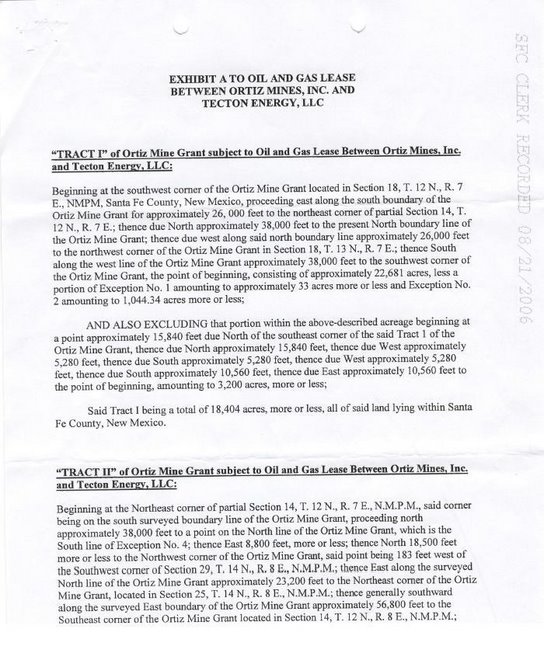
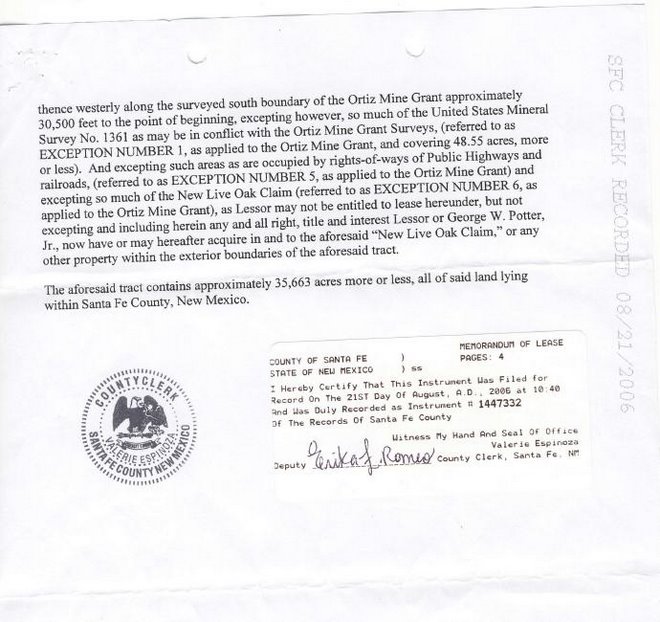
Agreement, Dated September 17, 2006 Between Westland and Tecton

New aquifer discovered on West Mesa

Posted at: 07/25/2008 12:48:05 PM
By: Eyewitness News 4
Print Story Email to a Friend

New aquifer discovered on West Mesa

A new potential source of water for the Albuquerque metro has been discovered under the West Mesa.

The deep-water aquifer was discovered on land owned by Atrisco Oil and Gas just north of Interstate 40 between two volcanoes.

An Atrisco spokesman says the water is trapped in a triangular fault block and could be as deep as 7,000 feet below the surface.

Atrisco officials say the company will need to do more testing on the water before they’ll know if it is safe for human consumption.

“We believe through our samples that we have the capability through a treatment process to commercialize this water and make it available to the Albuquerque community,” said Peter Sanchez of Atrisco Oil and Gas.

The testing is expected to take at least two years and cost more than a million dollars to complete.

This is the first deep-water project in the Albuquerque area. There are two more in the state: one near Ruidoso, the other in Sandoval County

Oil leaders turn to courts on drilling

Business News - Local News Click here to find out more!

New Mexico Business Weekly - by Kevin Robinson-Avila NMBW Staff

NMBW STAFF PHOTO
An oil derrick turns on U.S. Hwy. 550 near Farmington.
View Larger

The battle over where oil and gas companies can drill is heading to the courts.

The New Mexico Oil and Gas Association is preparing litigation to challenge Santa Fe County's authority to impose a moratorium on oil operations as part of an industry effort to clearly define the boundaries between state government authority and county jurisdiction, said association President Bob Gallagher.

Separately, Texas-based Approach Resources Inc. is already challenging, through the U.S. District Court in Santa Fe, a moratorium imposed by the Rio Arriba County Commission to block Approach's drilling plans near Tierra Amarilla.

"The litigation we're preparing regarding Santa Fe County will focus specifically on that county, but with the proper judgment, it will impact other counties like Rio Arriba by setting a legal precedent," Gallagher said. "We believe strongly that state law gives the authority to regulate the oil and gas industry solely to the state Oil Conservation Division and the Oil Conservation Commission. Moratoriums by counties should be pre-empted, because if every county were allowed to adopt their own separate rules and regulations, it would be mass confusion."

A favorable ruling by the courts in the association's litigation in Santa Fe or Approach's legal challenge in Rio Arriba will not automatically allow drilling activities in either place to go forward because of executive intervention in both counties.

Gov. Bill Richardson imposed a six-month moratorium last January on drilling in the Galisteo Basin southeast of Santa Fe. On July 18, he extended that moratorium to Jan. 24, 2009, to allow more time for state agencies to examine the potential local impact of oil operations.

In Rio Arriba, Richardson has not imposed a moratorium, but on July 21 he ordered the Oil Conservation Division to propose new rules for oil and gas activities in the county's eastern zones to protect water resources, human health and the environment where Approach is active, said division spokeswoman Jodi Porter.

"The governor has directed us to draft new rules in the regions around the Chama Watershed because it's more or less a wildcat area without a history of oil operations," Porter said.

Also, on July 18, the division canceled one of four drilling permits previously granted to Approach because further review showed the proposed well would be located in a wetland about 40 feet from surface water sources. The division suspended the other three permits as well and forwarded them on to the Oil Conservation Commission for review.

Curtis Henderson, executive vice president and general counsel for Approach, declined to comment on whether the state's actions will affect the company's litigation against Rio Arriba County, which in April imposed its own four-month moratorium on drilling to draw up a new local ordinance on oil and gas activities.

But Gallagher said the issue of county authority must be resolved despite executive action, especially in Santa Fe, where the county unilaterally declared a year-long moratorium on drilling in the Galisteo Basin independently from state government.

"The thought that a locally elected body can just take your livelihood away is scary, especially when there are tens of millions of dollars in expenses involved in projects," Gallagher said. "The law is very specific that cities and counties can take action to protect their water and waterways, but state statutes don't give them authority to impose moratoriums or regulate oil and gas activities."

Gallagher said a final draft of the Santa Fe litigation is now being prepared, although it's not clear which court the association will approach.

Apart from contesting the county's right to adopt a moratorium, the case will be joined by a local property owner with significant mineral rights to stop the county from "taking" his property rights away. Gallagher declined to name the owner, but said his inclusion greatly strengthens the case.

"I'm not sure any judge would ever rule that someone can take a property right away from someone," Gallagher said.

But county officials insist they have the right to impose rules and regulations to protect local communities from things like noise and air pollution.

"Local governments have authority over many issues that state statutes don't deal with, such as traffic, water contamination or industrial activities in residential areas," said Steve Kopelman, general counsel for the New Mexico Association of Counties. "Local government does have a role to play, and it's a very important one."

The Association of Counties filed an amicus brief in the Approach litigation to show that Rio Arriba and other counties do have authority over many local issues that affect oil and gas operations. The brief said the issue is of "critical importance" to every city and county in the state.

Santa Fe County spokesman Stephen Ulibarri said the amicus brief reflects his county's position in any litigation that might challenge Santa Fe's local authority. He said the county declared its moratorium in the Galisteo Basin to draw up a gross-management plan for the Basin that reflects broad input from local communities and industry experts on the best development plan for that area.

"We're looking at the big picture, not just an ordinance for the oil and gas industry," Ulibarri said.

Oil Conservation Division Director Mark Fesmire said a court ruling on the issue will help clarify state and local authority.

"I think there are some areas where the county can legitimately police oil activities, but where those boundaries lay will be settled when the case comes to court," Fesmire said. "Clearly, I have a different take than the Oil and Gas Association, but the right take is what the court comes up with."


krobinson-avila@bizjournals.com | 348-8302


All contents of this site © American City Business Journals Inc. All rights reserved.
Independent producers appeal oil, gas pit rules

New Mexico Business Weekly - July 28, 2008
http://albuquerque.bizjournals.com/albuquerque/stories/2008/07/28/story2.html

Click here to find out more!
Business News - Local News Click here to find out more!

New Mexico Business Weekly - by Kevin Robinson-Avila NMBW Staff

Unity in New Mexico's oil and gas industry has fractured somewhat over new state rules on oil and gas pits.

The Independent Petroleum Association is appealing the rules in Santa Fe District Court. That action is supported by an industry committee of 16 large producers -- including ConocoPhillips and Occidental Petroleum Corp. -- which filed a separate but complementary appeal.

Nevertheless, the New Mexico Oil and Gas Association -- which in May praised the new regulations as an acceptable compromise between industry and government -- firmly opposes the litigation, said President Bob Gallagher.

"I was surprised and disappointed by the appeal," Gallagher said. "Maybe we can't term our compromise with the government 'good,' but I believe it was reasonable and something we could work with."

The state Oil Conservation Commission approved the pit rules in June, following more than a year of stakeholder discussion and public hearings organized by the Oil Conservation Division.

The rules obligate operators to use heavy-duty liners in all pits to protect against seepage of contaminated materials. It also prohibits pits that are too close to water wells, and it requires operators to haul much of the contaminated water, soil and other materials to permanent disposal sites.

Still, industry negotiated a number of key compromises, such as significantly raising toxicity standards to allow more waste to be buried on-site in deep trenches rather than being hauled away, Gallagher said.

"My recommendation to our members was to allow the rule to shake out in the field for a few months and then collectively address any concerns with the Oil Conservation Division," Gallagher said. "I believe the litigation serves to alienate the regulatory authorities and may damage the good work accomplished over a 10-month period."

Karin Foster, director of government affairs for the Independent Petroleum Association, said her group disagrees.

"Bob believes we can still resolve this problem through negotiations, but we believe it's time to appeal it in the courts," Foster said. "We represent a lot of the same companies in our membership, but our organizations have a difference of opinion on this issue."

Independent Petroleum Association President John Byrom said that the cost of complying with the rules is just too much for small independent operators.

"It will cost an additional $50,000 to $250,000 to comply for each new well drilled, and that doesn't include costs to retrofit existing wells," Byrom said. "We're not looking for a battle, but our view on this is different from the Oil and Gas Association. Small independent operators will have a very tough time complying."

In its appeal, the association argues that no economic impact study was done as required by the state Small Business Regulators Relief Act and no transitional provisions were included to ease the conversion from old to new standards.

But state officials dispute the association's cost estimates. During pit rule hearings, independent operators testified that the costs for compliance would range from $35,000 in shallow wells to $150,000 in deep wells, said Oil Conservation Division spokeswoman Jodi Porter.

"Their numbers are off," Porter said. "Our estimates come right from the transcripts of testimony by operators at the hearings."

Porter said it would be far more costly for operators to clean up contaminated sites.

Division Director Mark Fesmire said he believes the appeal will fail.


krobinson-avila@bizjournals.com | 348-8302


All contents of this site © American City Business Journals Inc. All rights reserved.

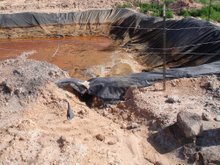
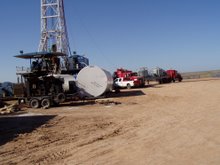
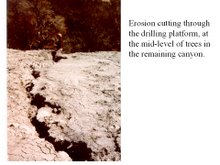
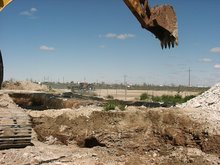
Some great pit pictures at Bluedaze, click here.