CNN's Susan Candiotti checks out a promising biodiesel fuel from a golf-ball sized fruit whose oil runs diesel engines.
Source: CNN | Added August 11, 2008
| |||||
| Oil and gas ordinance update
We also talked with KSFR reporter Marion Cox, who is also a business professional involved in the same type of public involvement planning for municipalities. She raised questions not addressed by Freilich. Her audio runs about 6 minutes in the same file. KSFR will have more on this question of the planning process for Santa Fe County in the coming days. © Copyright 2008, KSFR |
| |||||
| Mineral rights in Santa Fe hard to track down
It's not an easy question to find the answer to, as our reporter KSFR's Norman Mark found out. © Copyright 2008, KSFR |
High Country News:
BLM set to open Colorado plateau to gas drilling despite broad opposition
The Santa Fe County Board of County Commissioners (BCC) will meet tomorrow (click here for agenda). Dr. Freilich will brief the BCC on the progress of oil & gas. An update and response to the briefing will be posted at drillingsantafe.com .
REGULAR MEETING
(Public Hearing)
August 12, 2008 – 3:00 pm
XII. Staff And Elected Officials’ Items
A. Growth Management Department
3. Briefing On The Progress Since Adoption Of The Interim Development Ordinance Relating To Oil and Gas (Dr. Robert H. Freilich)
CDRC (County Development Review Committee): August
The New Mexico Oil Conservation Division has detected and documented more than 700 hundred incidents of groundwater contamination from oil and gas facilities across the state. The data can be downloaded from the OCD web site (click here to download a pdf version or an Excel spreadsheet version).
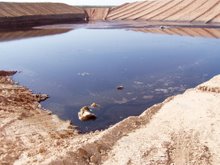
Taking pit water quality samples in San Juan County, New Mexico.
Prior to 1990, only 39 orders were issued against oil and gas companies for contaminating groundwater. The earliest order was issued in 1954. Since 1990, 705 incidents have been recorded, for a total of 743 documented groundwater incidents related to the oil and gas industry in New Mexico.
Of the 743 groundwater contamination incidents, more than half have been caused by contamination from oil and gas industry pits.
The Oil and Gas Accountability Project has created some graphs to summarize the OCD data. These graphs show:
The Albuquerque Journal:
Sunday, August 10, 2008
By Copyright &Copy; 2008 Albuquerque Journal By Andrew Webb
Journal Staff Writer
The issues featured prominently in the interplay between keynote speakers, Lt. Gov. Diane Denish and Michael J. Economides."...
..."Members also received synopses of other issues under consideration by the state's Oil Conservation Division. Among the issues was a discussion of whether counties could create ordinances more strict than OCD's.“The court affirmed what the California legislature made clear: that global warming must be addressed in land-use decisions,” said Jonathan Evans, a staff attorney with the Center.
Threats to Vital Wildlife Areas
Most of the Palmwood site lies within regionally recognized wildlife conservation areas. The project area is home to numerous species of rare wildlife including bighorn sheep, burrowing owls, the Palm Springs pocket mouse, Palm Springs round-tailed ground squirrel, Le Conte’s thrasher, and loggerhead shrike. The area is also part of a wildlife linkage providing a bridge for animals to the adjacent national park and wilderness areas.
“This project would have destroyed vital habitat of some of the most endangered species in the Coachella Valley,” said Evans. “This ecological and financial disaster should never have been approved.”' More>>>>
In a phone interview Friday, County Manager Shawn Nau said the wording adopted by the commission closely mirrors wording currently proposed for the state's revised gas and oil regulations.
In other action Thursday, planning commissioners voted to also make the following amendments to the drafted regulations:
"FORT WORTH, Texas (AP) - Holding "Just say, Whoa!" signs, about 300 people rallied Thursday to urge Fort Worth leaders to stop natural gas drilling permits and pipeline easements in the city...."
"...We expect the city to put a moratorium for as long as it takes to address these issues," said Cathy Hirt, a former City Council member who helped form the Coalition for a Reformed Drilling Ordinance. "With such a large, diverse group of people here from all walks of life, it speaks to the fact that this is not a small group of naysayers — it's a cross-section of the community who have a lot of concerns...."
"...They are also concerned about companies using eminent domain to acquire property for pipeline easements.
Last week Chesapeake Energy's subsidiary, Texas Midstream Gas Services, started condemnation proceedings against a 72-year-old woman who refused the company's offer of nearly $13,000 for a 20-foot strip across the front of her 100-foot-wide lot.
The pipeline, which would be 10 to 20 feet underground and connect two well sites along an interstate, requires easements under the front yards of nearly 50 homes and vacant lots." More>>>>
Related Story: "Urban Gas Drilling Causes Backlash In Boomtown "
"Chesapeake Energy's CEO, Aubrey McClendon, is a big believer in aggressive media campaigns. He was a major backer of the Swift Boat Veterans for Truth, the group that attacked Massachusetts Sen. John Kerry's military record when he ran for president in 2004, and other right-wing causes.
The comany's stock market value tops $28 billion, and last year McClendon's compensation and stock options totaled nearly $19 million.
In the wake of Chesapeake's infomercial comes Shale TV, a daily talk show about the Barnett Shale set to air this fall. The company has hired three award-winning Dallas broadcast journalists to produce the show.
Julie Wilson, Chesapeake vice president for corporate development, says she understands there's skepticism about the objectivity of Shale TV, but she insists it's no different than the rest of corporate media.
Selected excerpts from ProPublica:
"New York City officials have demanded a ban on natural gas drilling near upstate reservoirs because they fear the drilling could contaminate the city's drinking water.
Chesapeake Energy, whose CEO is Aubrey McClendon, has launched an aggressive media campaign to burnish its image. APAll Things Considered, August 5, 2008 · The Barnett Shale, a natural gas-bearing formation underneath 21 counties in north Texas, is a wildcatter's dream: Wherever energy companies poke a hole, there's gas. Now they're scrambling to drill anywhere there's vacant land — at country clubs, parking lots, city parks, school grounds and airports.
But a vocal and growing minority is not getting behind the Barnett Shale, even though Texas-born actor Tommy Lee Jones urges them to on recent billboards and in newspaper and television ads. Jones is a corporate spokesman for Chesapeake Energy, the nation's largest independent producer of natural gas and the biggest player in the Barnett Shale.
Jerry Lobdell, a neighborhood activist in Fort Worth, said he feels the energy companies played bait and switch now that pipeline companies are coming into neighborhoods with the power of eminent domain and plans to run odorless gas lines under front yards. The companies insist the gas lines are perfectly safe.
"They came in, they spoke of bonus money and royalties," he said. "They never said anything about pipelines whatsoever or any of the other bad things that we've learned about." More>>>>
"Friends of the Earth’s new analysis shows that even though the oil and gas industry is experiencing record profits, it is set to receive at least $33 billion in handouts from taxpayers over the next five years. These companies stand to gain at least $23.2 billion from tax loopholes, $3.8 billion in royalty rollbacks, $1.6 billion in direct subsidies for research and development, and $4.3 billion through accounting gimmicks. The tax giveaways have increased dramatically since the passage of a Republican-drafted energy bill in 2005." Maybe the industry of "Big Oil, Big Influence" should not only take into account these giveaways, but also the threat to human health, the OCD fining structure not updated since 1935, the exemptions from varying environmental acts, and the concept of too much drilling for natural gas.
Planning Works direct link page 64 , click here. Results were as follows:
County should encourage extraction: 3%
Extraction should be subject to specific conditions: 0%
Extraction should be subject to specific conditions and prohibited from specific areas: 10%
County should ban all oil/gas extraction: 87%
No Opinion: 0%
The mission of Drilling
Bob Gallagher of the New Mexico Oil and Gas Association noted that the state's landowner protection law, which just went into effect July 1, was borne out of cooperation between landowners and energy companies. The result was a balanced, fair bill that protected both sides, he said.
"It does not delay or deny access to mineral resources," Gallagher said.
Gallagher implied that the federal legislation, by contrast, is too one-sided. "It is not a good start. It is not a good finish. It was not written by someone in the field doing the work," he said.
Aside from the split-estate provisions, H.R. 2337 would amend sections of the 2005 Energy Policy Act that accelerated oil and gas drilling on public lands, severely limit the Interior Department's royalty-in-kind program and establish a fee on nonproducing leases. The measure also aims to bolster carbon sequestration studies and require new studies for wind power siting, and it would establish an intra-agency panel to address the effect of warming on federal lands, oceans and federal water infrastructure (E&E Daily, July 16).
Gable is an independent energy and environmental writer in Woodland Park, Colo
The House of Representatives will vote next week. Congressman Udall: Phone 202-225-6190 or 505-984-8950