Tuesday, October 16, 2007

What are the consequences of oil & gas drilling in Santa Fe County - intended & unintended?

What are the consequences of oil & gas drilling exploration to Santa Fe County -- intended and unintended? To begin to answer that question, there must be independent hydrogeological, environmental, cultural, and adverse economic impact studies conducted.

Santa Fe County is in a unique position. The citizenry of Santa Fe County has the fortitude to support County officials, who will stand up to the oil & gas industry.

There are some people who have expressed uncertainty about the County’s authority to protect our precious water resources from oil and gas activities. We believe that this uncertainty is misplaced and that the County has full authority to protect its water resources – both surface water and groundwater – from the certain damage that would be caused by oil and gas activities. We further believe that it would be disastrous for the County to "throw in the towel" on the basis of a perceived preemption issue, instead of exercising its full authority under the New Mexico Constitution and New Mexico statutes.


Likewise, we believe that it is unlikely that a court would find that the County does not have authority to protect the County's water resources from the adverse effects of oil and gas activities. We have looked carefully at the State's Water Quality Act and the State's Oil and Gas Act. Looked at together, it seems clear that the New Mexico legislature has intended to preserve the authority of local governments to protect water resources more stringently than those resources are protected by the State.

To write to your elected officials: Santa Fe County ; New Mexico Legislature ; U.S. Congressmembers ; Sample Letter .

Disclaimer: The views expressed are those of Drilling Santa Fe.

Tuesday, October 9, 2007

How many barrels?

"This world uses a thousand barrels of oil a second-- that's 86 million barrels a day. With China, India and other emerging nations continuing to grow, that number's not going anywhere but up."
-- mywesttexas.com

"According to Dirks, the portion of the rift between Santa Fe and Socorro may contain one of the largest hydrocarbon resources in New Mexico, containing 50 to 100 million barrels of light sweet crude oil and 5 to 10 trillion cubic feet of natural gas." -- Tecton Energy, LLC Press Release, September 19,2007.

Enough oil for just about a day of current world consumption; but, what about the adverse economic, cultural, water source, and environmental impacts to Santa Fe and Santa Fe County?


Tuesday, October 2, 2007

Produced Water

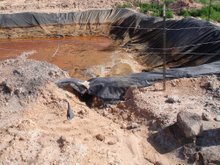
Produced Water: "Any water that is produced to the surface along with oil or gas." "It is the largest waste stream generated by the oil and gas industry." Oil and Gas Accountability Project

"For every barrel of oil produced, approximately 10 barrels of brackish or saline water is generated." Sandia National Laboratories

Thursday, September 27, 2007

Upcoming Events & Information

There are some important upcoming oil & gas meetings. For information, go to High Desert Reports and to a Flyer received.

At these meetings, "closed-loop drilling systems" will be discussed. To learn more about true closed-loop drilling systems, go to WorldOil.com . Also, an OCD Press Release about an award for the pitless drilling system.

From the The New York Times an article regarding, "Minerals Management Service, the agency within the Interior Department responsible for collecting about $10 billion a year in royalties on oil and gas."

Monday, September 17, 2007

Future Water - 3 Part Series & Report: Drilling surge projected across West, The Santa Fe New Mexican

Click here for the third in a three part series. Under "related stories"of this story at the SantaFeNewMexican.com, there are links to the previous two stories of the series.

Click here for the article about the Wilderness Society oil and gas drilling report.

Sunday, September 9, 2007

Texas Firm Cancels Drilling Plans

From the Albuqerque Journal:
"A Texas engineering firm has reportedly dropped plans to drill for coal-bed methane in the pristine wildlife area that supplies the city of Raton's drinking water....
The city last month filed suit to bar the drilling. Raton officials feared that the huge volumes of groundwater pumped to the surface as part of the drilling process could pollute and diminish water supplies....
'The city will continue to be proactive in opposing any future drilling activities which do not accommodate and protect its water rights from depletion and contamination,' the city said."

Letter to the Editor: "Drilling for Oil and Gas in Santa Fe County"

From the Sun Monthly:

"Meanwhile, the National Energy Bill, currently before Congress, includes an exemption from the Clean Water Act for the effects of fraccing (thanks to Dick Cheney's secret energy task force). This means that municipalities and individual property owners have to bear the burden of health risks, cleanup and property damage from groundwater contamination caused by hydraulic fracturing. Call senator Bingaman (988-6647) and Representative Udall (984-8950) to ask that this exemption be taken out of the energy bill." See "Fracing and Water" on this site.

Friday, September 7, 2007

Tweeti Blancett - She's Back!


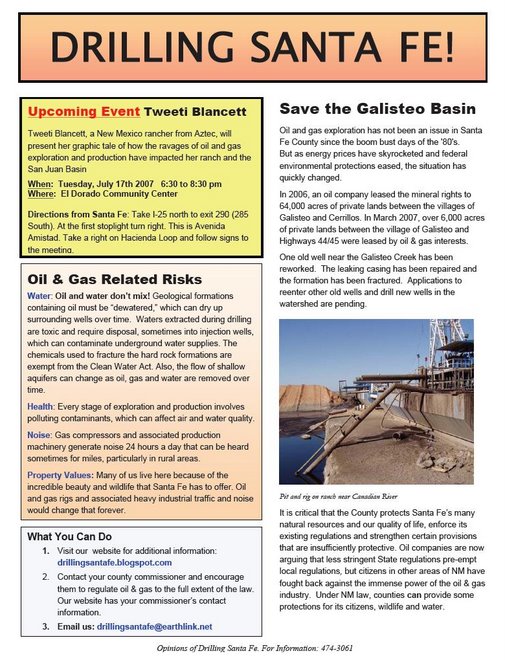
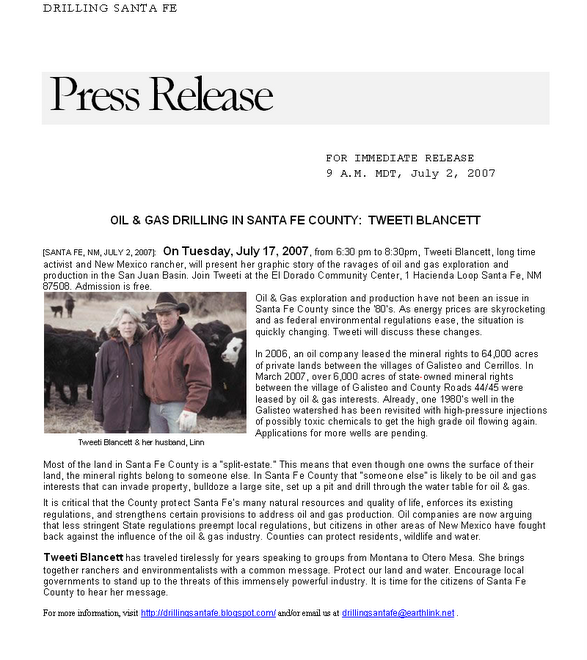
Galisteo Community Association is bringing Tweeti Blancett back to Santa Fe County for an important public meeting. Tweeti Blancett, a New Mexico rancher from Aztec, will present her graphic tale of how the ravages of oil and gas exploration and production have impacted her ranch and the San Juan Basin.


When: Sunday, October 7, 2007
7:00pm to 9:00pm

Where: The Galisteo Community Center

Directions: Across from County Road 42 (as well as, across from the church) is Via La Puente. Go east on Via La Puente and cross the wooden bridge over the Galisteo Creek. Stay to your right and pass the Fire Station. The Community Center is on the left (east) side of the road.
Mapquest map

Contact: Muriel Fariello: 466-4763

Thursday, August 30, 2007

Public Health and Toxics

From Earthworks: "There are a variety of chemicals used during the drilling and production phases of oil and gas; and different types of wastes are produced throughout the development process.

The purpose of the Oil & Gas Accountability Project's Public Health and Toxics Program is to help communities and citizens better understand and protect themselves from the health and environmental impacts associated with toxic oil and gas chemicals and wastes."

Link to Earthworks

Earthworks O&G Factsheet

Tuesday, August 28, 2007

Atrisco Oil & Gas, LLC agreement with Tecton Energy, LLC

The deal to sell Westland Development Co. last year may become more lucrative for former shareholders.
Atrisco Oil & Gas LLC announced Monday it has made an agreement with Tecton Energy of Houston to search for natural gas on 50,000 acres that once were part of the Atrisco Land Grant.


Albuquerque Journal article -- subscription required

Atrisco Oi & Gas, LLC article

Saturday, August 11, 2007

Fracing and Water

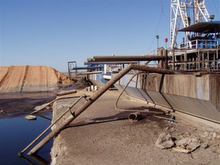
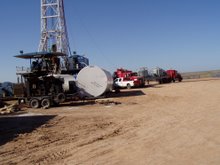
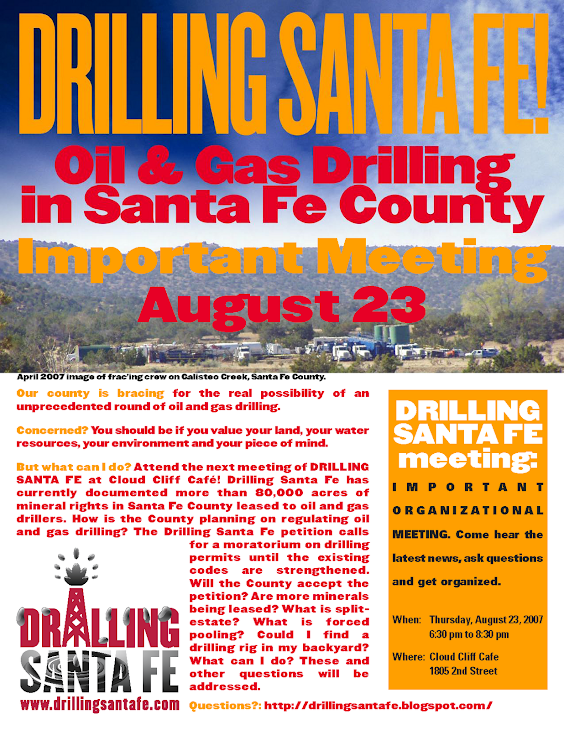
Originally, Drilling Santa Fe began, "Drilling in Santa Fe County?" with a picture of a fracing crew along the Galisteo Creek. About fracing, from a editorial in the WCMessenger.com, "Depletion: Barnett Shale wells require fracturing of the limestone formation to release the oil and gas trapped within. Water, sand, and hazardous chemicals are injected under high pressure down the drilling hole to fracture the limestone. Each fracing uses between 1.5 and 6 million gallons of fresh water. According to Halliburton at the Petroleum Technology Transfer Council, each well is fraced an average of 17 times." (see related article, "How Halliburton Technology is Wrecking the Rockies" & "EPA to citizens: Frack you" & "The Costs of Fracking")

Consequently, Texas legislation, "Written by Sen. Troy Fraser, R-Arlington, SB 714 would require drillers to report groundwater use for drilling and fracing. This process of forcing sand and water into wells in order to release the gas can use up to 5 million gallons per frac, and as many as 17 fracs for certain kinds of wells. SB 715, also written by Fraser, would require better public notification of proposed injection wells so that the public can participate in the permitting process." DentonRC.com

Other concerns from the Telluride Daily Planet, "Amos said that in 2001 EnCana had a fracking accident less than 100 yards from her home, which blew up her water well 'like a geyser at Yellowstone.' For a time, the company paid for drinking water for her family, then assured her that the well water was fine. Later she became ill and was diagnosed with a rare adrenal gland tumor, which is linked to 2BE, a benzene derivative, and a chemical used by EnCana for fracking."

From a subscriber, "According to the article, a frac can use 5,000,000 gallons of water -- that is more than 15.3 acre feet. Also according to the article, some wells are fraced as many as 17 times, for a total of 260 acre feet of water. Using the County's figure of 0.25 acre feet of use for a normal household/year, fracing one well could use as much water as 1,040 households would use in an entire year!"

*Click on the bold, underlined above to link to articles.


Friday, August 10, 2007

KSFR "Journey Home" with Diego Mulligan Interview

Please tune in to “The Journey Home” with Diego Mulligan for an interview with Drilling Santa Fe at 4:00pm, Tuesday, August 21, 2007.
Also, to get some background of oil & gas exploration in Santa Fe County, please listen to "Living on the Edge" with David Bacon and Zubi Wilson forty minute interview with Drilling Santa Fe originally aired on July 22, 2007. For the direct link to the interview, go to R3 Productions.

Link list:
http://www.ksfr.org/
http://www.r3productions.net/local.htm

Thursday, August 9, 2007

Have the Drillers Leased the Minerals Under Your Land?


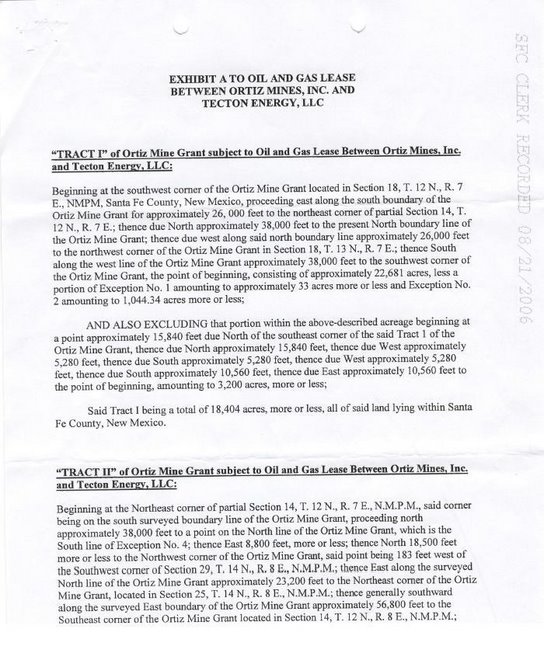
Most land in Santa Fe county is split-estate. Most residents only own the surface of their land. The sub-surface rights belong to previous owners or the State or Federal government, and legally, the mineral rights take precedent over your surface rights. Oil & gas interests can lease those mineral rights without your knowledge. As of August 1st, Drilling Santa Fe has documented more than 80,000 acres of mineral rights in the Galisteo Basin and the Ortiz Mountains leased to oil and gas drillers.


Mineral owners should require stringent environmental restrictions in their leases. However, enforcement is difficult and seldom occurs with absentee mineral owners. The surface owners and neighbors are left with the damages.


The new Surface Owners Protection Act became law on July 1st, but it offers little protection for the environment, the water, or the neighbors.
Disclaimer: The views expressed are those of Drilling Santa Fe.


Article about the Colfax County experience and why Santa Fe County needs strong regulations, monitoring and enforcement: "The Real New West: Colfax County, New Mexico Successfully Beaten Into Place."

"Essentially, the people of Colfax County are throwing away their land, water, air, health and economic future for....well, nada mucho."

Wednesday, August 8, 2007

Statistics for Thought

Who Owns The West?
"Oil produced in New Mexico from 1989-2003 totals 329.2 million barrels, an average of 1.2 day(s) of U.S. consumption per year."
The article has some statistics to ponder when considering the adverse impacts of oil and gas drilling to water, environmental, and cultural resources. There are also adverse economic impacts.
Disclaimer: The views expressed are those of Drilling Santa Fe.

Saturday, August 4, 2007

Coal Bed Methane Drilling in Sugarite Canyon

"Sweet Sugarite: Time to speak up to protect treasured wild areas" - The Raton Range

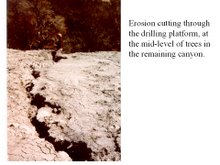
"CBM (coal bed methane) drilling allegedly can pollute and deplete groundwater, trigger erosion, impact wildlife, and create noise and light pollution."

Save Our Sugarite (SOS)

Thursday, August 2, 2007

Gas Well Blowout

"Groups call for halt to drilling for remediation"- Billings Gazette
"That well suffered a blowout in August 2006. The incident released contaminants underground and into nearby springs and forced gas condensate and drilling fluid to the surface."

Wednesday, August 1, 2007

Commentary: Fluid response to Otero Mesa

Nathan Newcomer - Albuquerque Tribune
"In 2002, a leak was discovered in a 6-inch crude oil gathering line near Monument, just south of Hobbs. Approximately 2,100 barrels of oil leaked from the pipeline, contaminating five acres of soil and polluting groundwater. This pipeline was only two years old.

In 2005, the New Mexico Oil Conservation Division compiled information regarding groundwater effects from leaks, spills and releases from oil and gas operations. There were close to 1,400 groundwater pollution instances that are attributed to oil and gas activities over the past decade.

Industry can wax poetic all it wants when it comes to "environmentally sound drilling," but the facts and data demonstrate their failure to protect our dwindling water resources."

Saturday, July 28, 2007

The New Mexican Articles

"County seeks to ease oil-drilling fears" -"Don’t panic. The public will have a chance to weigh in before new oil or gas drilling starts in Santa Fe County." (see previous article, "Oil drilling fears erupt in Galisteo, Cerrillos")

In response to the article in The New Mexican, July 24, 2007, “County Seeks to Ease Oil-Drilling Fears,” Drilling Santa Fe would like to make the following comments. First, it is good that the County will allow the public “a chance to weigh in.” Oil and gas exploration could adversely impact our health and our land. Water wells and aquifers could be damaged. Our limited supplies of water would be depleted, since oil and gas exploration and production require vast amounts of water.

The article states, ‘“Think about the amount of tax revenue it could bring to the county,” Ulibarri said, citing the approximately $8.2 billion dollars in natural gas revenue generated annually in San Juan County, in northwestern New Mexico.” We would clarify that a small fraction of the tax revenue actually is returned to the County. Much of the gross revenue leaves New Mexico, since many of the producers there are out of state.

Although “county officials don’t think there are great untapped sources of oil in the county,” without strict regulation and enforcement, damages can and do occur. Exploration brings a strain on the infrastructure with the influx of temporary workers and the road building and maintenance required for every well.

For example, an extensive study conducted for Valle Vidal concluded, “Committing the spectacular natural landscapes of Valle Vidal to commercial mineral development will not bring real economic development to Colfax County.”

"Energy development has high opportunity costs" - Sonoran Institute

Chicago Tribune, "In Minority Neighborhood, Kid's Risk of Cancer Soars," printed in The New Mexican, 'Environmental Racism'

Farmington Urban Well Pad


(Click on picture for larger view)

About the picture from a Farmington resident: "Here is a picture I took in Farmington a couple of days ago... note that this is inside a city that has a lot of good regs....but look at how close this is to the house (most regs are written for the distance from the well head to a structure... not from the pad perimeter). This well pad fence comes up right to the edge of the house and garage. It has an opaque green slat fence but the pad still is huge (acres) and has those big buildings that house the noise and other things. Notice the area... really nice large expensive homes... other areas of Farmington do not have this quality of enclosures...this is the best I have seen. Enclosures, noise specs, and closed loop are some things that should be demanded from the county in their new code. Even in the best of circumstances, this example below may be the best that anyone can expect here in NM, short of directional drilling from a remote consolidated location."

Farmington Urban Well Pad Upclose


(Click on picture for larger view)

From a resident in the Farmington area about picture: "Here is a shot of tank and housing on the pad from a different angle with with house roof showing in back. Backing out of the garage goes right up against the fence. People in Eldorado and Santa Fe need to know this could happen to them with much less protection and mitigation unless they can get really good codes in place."